
A friend showed me how to use Chat GPT, which was alien to me, when we were in Panama, and she couldn’t get the rental car gas cap open to refuel. She showed a video of the problem to Chat GPT and talked to it like it was a regular person. And she—Chat GPT— talked back—and solved our problem.
I was enthralled, then hooked. I bought a subscription. I made a logo. I made a cartoon of myself. I researched history for a project—boom! I sought answers in science, astronomy, vacations and even rock bands. Answers came not in minutes but seconds! This was saving me hours and hours of research, and gave me new ideas. And it was very personalized, except it keeps calling me Laureen, which only my parents ever did when they were angry with me, or the Sisters of St. Jospeh in Middle School (who probably were mad at me too).
I thought about the days, weeks, month, years spent researching my books Raising a Child with Hemophilia and A Guide to Living with von Willebrand Disease. How much time could have been saved!
Then I wondered if people were turning to Chat GPT for problems they were having with their child with hemophilia. Were they asking things like, “What does a 5% level mean in hemophilia?” “What do I do when he as a multi-color bruise?” “My son just hit his head, What should I do?” Should we use Chat GPT this way? Is it helpful?
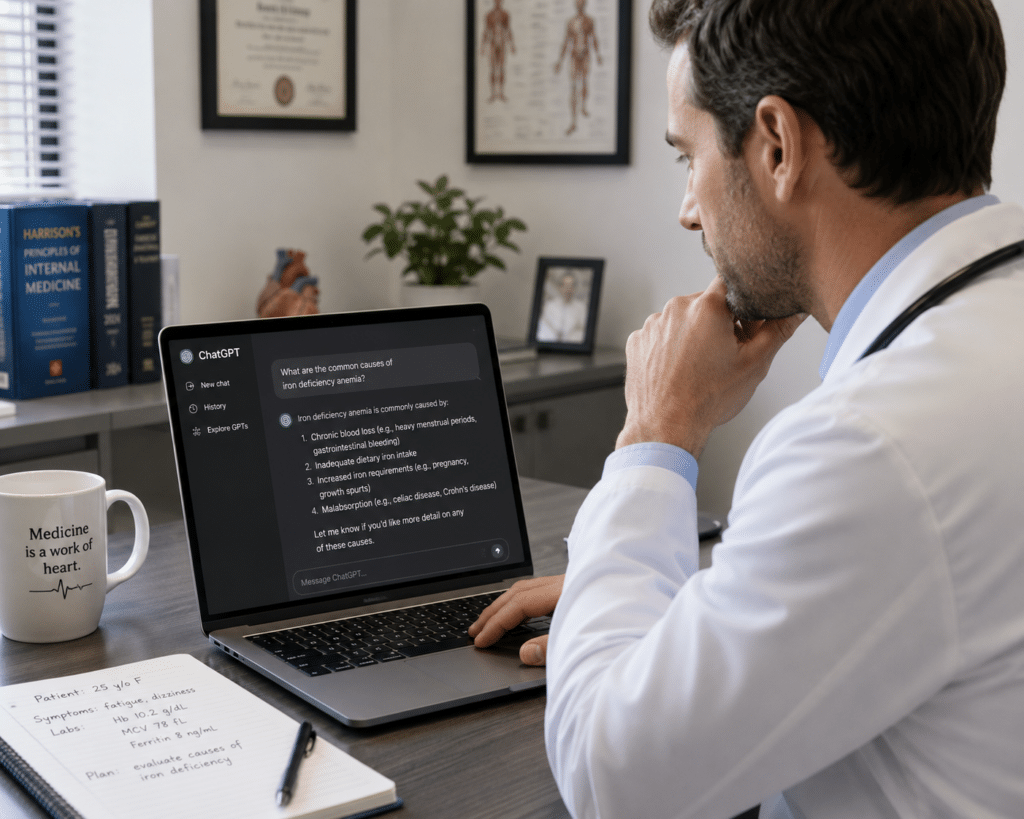
And it’s not just patients who are using AI, which is what Chat GPT is. Te-Ping Chen and Chao Deng in The Wall Street Journal say that health care has become the testing ground for Al. Among health systems, 27% are currently paying for commercial Al licenses, triple the rate across the U.S. economy. Doctors and administrators use it to take notes, “field phone calls, and deal with insurance claims” — and give health advice. A study last year found that “Al was better able to identify subtle signs of breast cancer” than human radiologists. And OpenAl, which owns Chat GPT) now inaugurated ChatGPT Health: Al can view medical records and wellness apps for a tailored medical response. More than 40 million people a day already turn to ChatGPT with health questions, and it’s available 24/7.
And usage is rising among patients. According to the New York Times, roughly one in six U.S. adults (and one-quarter of those under 30) use AI chatbots like ChatGPT for medical advice at least once a month. Why? People ask it to explain new symptoms, to research conditions, and to vet a doctor’s advice. Patients get tired of long wait times, short doctor appointments, and high medical bills.
Addressing these needs, some health systems are obtaining commercial AI licenses (27% in early 2026) to help manage patient messages. And as mentioned, OpenAI launched Chat GPT to allow AI to integrate with medical records and apps.
This is a new era, a Wild West, and there are concerns. “This has the potential to “backfire spectacularly,” said Parmy Olson in Bloomberg. People can be wary uploading their health records to a company that could use personal information for advertising purposes. For those of us with hemophilia and other bleeding disorders, this is a bit unnerving. Also, bleeding disorders require expert knowledge, as life and death could be involved. Is AI aware that bleeding disorders can be life threatening, of how serious bleeds can be?
Chat GPT is not infallible. I caught it in a couple of mistakes during my research, which it acknowledged—and then praised me! This made me extra careful whenever I asked it for a definitive, factual-based answer. I think these are called “hallucinations,” when chatbots provide dangerously incorrect information or fabricated advice.
Health care staff and patients look to resolve high prices, accurate information, privacy, and self-knowledge—how to manage a bleeding disorder at home. AI can support a lot and be a great starting point for discussion and question, but nothing can take the place of reaching out to parents who live with a bleeding disorder, in on-line Facebook groups, and most importantly, your hematology staff at your HTC. Other parents and Chatbots are good for supplementary advice and info, but ultimately, you need to see if you HTC hematologist in in.
“Dr. Chat GPT will see you now.” Pg 20 The Week magazine. 2.4.26
Chat GPT created this royalty-free, unique photo for this blog!

1 thought on “The Doctor (ChatGPT) is In”
Save One Life’s ambassador and Italian hematologist Gianluca Sottilotta made an abstract on ‘AI and hemophilia’ for the World Congress in Kuala Lumpur. Worth checking!