
von Willebrand disease

A Haunting, a Murder, Secrets and VWD

All Hallows’ Eve, or as we call it tonight, Halloween, is the perfect time to share a novel about a haunting, a murder, secrets and von Willebrand disease!

Cassandra “Cassie” Mitchell is divorced and in her late 30s. She lives in her family’s home, called The Bluffs. Cassie’s great-grandparents built the Victorian house located in Whale Rock Village on Cape Cod, Massachusetts. And Massachusetts has its share of haunted house stories! The Bluffs is haunted, and the spirits there making their presence felt by emitting odors, scents or aromas – acrid or pungent like burning sugar when displeased, or sweet like caramel when approving.
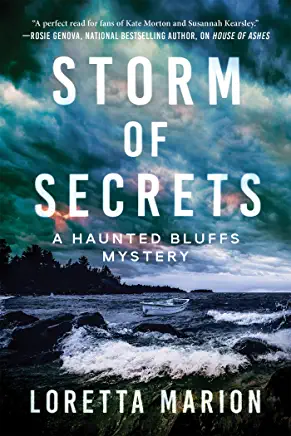
Cassie and her older sister Zoe deal with the Mitchell “family curse,” in which the women suffer from miscarriages and stillbirths, just like their mother did. But they don’t know what causes this curse.

Cassie is engaged to Daniel Benjamin, 45, a retired FBI agent from Boston. But they must postpone the wedding after Hurricane Chantal strikes—the storm becomes a metaphor for ripping the lid off things, especially family secrets. One day Cassie discovers a dead body rolled up in a rug inside a dumpster. Simultaneously, Benjamin assists local police after a 3-year-old boy goes missing. Strangely and coincidentally, a drowned boy washed ashore in 1969 and was found by Cassie’s father. He is called The Barnacle Boy and, as a local legend, is buried in the Mitchell family plot. The grave is visited by a mystery woman who Cassie tries to track down.

Besides the suspicious behavior of the missing boy’s parents, another suspect, Christopher Savage, stays in the carriage house at The Bluffs after the storm. Christopher, who professes his innocence, is friendly with the missing boy’s older brother, who won’t talk to the police. Christopher is a prep school history teacher in New York with a questionable past.

Eventually, the police, with some insight by Cassie, learn of multiple interconnected lives. Three orphaned Italian children moved to Boston to live with relatives in the early 1960s. One, Renata, became a nanny to the Welles family, and later pregnant from the eldest Welles son. Never informing them of the child, Renata left employment for the Welles family, to raise her son, Antonio. Mrs. Welles realizes the connection that, due to their nosebleeds, both her son and Antonio had Type I von Willebrand disease.

Here’s the big connection: To keep Antonio from the Welles, Renata let her brother take him by boat to New York to start over, but Antonio fell overboard during the storm in 1969. He was the Barnacle Boy! Renata became Renee after moving to New York, where she married and had another son named Christopher Savage. Renee never informed her new family of her past before she died of cancer. Yet her sister Isabella locates both her nephews: Antonio’s grave, and Christopher in person, who she had never met before, on Cape Cod. Both nephews, when children, had been given St. Christopher medallions, a clue that confirms their family connection.

Two weeks after the storm, Cassie and Benjamin, along with the police, discover the true cause of death for the victim in the dumpster – an accident that was covered up – and the reason the young boy was hid by his older brother during the storm. A month after the storm, Cassie sees a genetic specialist who finds a genetic abnormality that explains the Mitchell family curse—though not von Willebrand disease? The novel never reveals what it was. Still, Cassie becomes pregnant, pleasing the spirits! And there’s nothing like good spirits.

The book gets 70% 5 stars on Amazon.

Loretta Marion, 2019, Storm of Secrets: A Haunted Bluffs Mystery. New York, NY: Crooked Lane Books. 327 pages.

Recombinant VWD Product on the Horizon?


I just received word that Baxter has started Phase III of its recombinant VWD product. The investigational product is BAX 111, the first recombinant von Willebrand product in clinical development.

Currently, we have Humate-P (manufactured by CSL Behring) and wilate (manufactured by Octapharma), which are both plasma-derived. Wilate was the first product indicated for the treatment of bleeds in VWD patients. Humate-P has been the standard for years in the US. But don’t forget Alphanate (from Grifols), originally for treating hemophilia A bleeds, and now indicated for treatment of VWD patients (FDA-approved for surgical and/or invasive procedures in certain patients with VWD). Not FDA-indicated but sometimes effective is Koate-DVI (Grifols, distributed by Kedrion in US), because it has VWD in it, along with FVIII.

No one can say that America doesn’t have choice!

It’s always exciting when there are new products on the horizon. Please remember too that all US FDA-approved drugs are considered both safe and effective for treatment of bleeding for VWD patients.

The Baxter study will assess a minimum of 36 patients in trial sites in the United States, Canada, Europe, Australia, Japan and India. Information about the trial including enrollment is available at www.clinicaltrials.gov or by calling 1-805-372-3322.

I am quite sure, that when and if the product hits the market, Baxter will think of a catchy name for BAX 111!

For more info, call Marie Kennedy, (805) 372-3543– I know her and she is a very trusted source and nice person!

Interesting Book I Just Read
The Nine Rooms of Happiness
by Lucy Danziger and Catherine Birndorf

This perky, feel-good book uses a clever metaphor for getting women to think about their life, stress level and aspirations: think of your life as a house, and each segment of your emotional life is a room. Basement (memories, childhood), Family room (family), living room (friends, relationships), bathroom (self-esteem, health) etc. In which room are you? Where do you have the most problems? Is your bathroom too close to your family room? In a sense, the authors are asking us to compartmentalize, ironically a task usually associated with men. The authors use real life vignettes from women of varying backgrounds and situations to reveal some universal anxieties women share, and then applying the “house” metaphor to show how they can get unstuck from their unhappy situation, and move into a different room, and therefore happiness.

Sound simplistic? It is. The book is okay for those new to the self-help genre and studying relationship and introspection; I think they will read it and come away feeling understood, optimistic and less alone with their unhappiness. But to someone who is well versed in more serious relationship books (Harriet Learner has excellent ones), this is psycho-lite. The book is based on many presuppositions: woman must have female friends, you must keep old friends in order to be happy (even if they drive you batty?), women are prone to anxieties, women are unhappy. I found the book putting much blame on women for their condition, which I am sure the authors didn’t intend! For example, why should a woman be made to feel in “denial” about getting older, or narcissistic because she tires of her long-time friends who are aging, speaking about grave plots, and do nothing to engage in life, while she is full of spirit and wants to take on life and adventures? Why is that a “problem,” as the authors clearly state? They insist she needs to keep these stick-in-the-mud friends while cultivating new friends. What is she doesn’t have time? What if some people really are just jerks and not just a result of a relationship problem stemming from “regression,” or “transference” or “denial”? The authors seem to have a psycho answer for everything, and not a street-smart, pragmatic way of viewing relationships.

A cookie cutter response to each vignette wears thin, as do the clichés, which run rampant (oops, there I just did it) in the book. “To have a relationship, you first have to relate” –really? The model is a clever idea, using a house, and no doubt some will feel helped by this book. It’s gotten pretty mixed reviews. Maybe good for novices, but when you finish this, move on to some serious relationship books, as this one is pop-psychology, cutesy and sends mixed messages. If you challenge the presuppositions, half the book is sunk. Two stars.

HemaBlog Archives
Categories