Laurie Kelley

Pondering Pain

All last week we at LA Kelley Communications were putting the final touches on the November issue of PEN, which is all about pain management. Ironically, in the middle of editing, I was off to see an orthopedic podiatrist for an extremely painful foot. For months I’ve been getting out of bed, unable to put pressure on my right foot, until I hobbled about enough to finally ease the arch down a bit. For a couple of months I thought it was just “old age,” and overuse from trying to run 6 miles in the morning, when I should be running about 2. The ortho said no; it was a too-tight tendon. Plus, my right leg is a bit shorter than my left! So he will make me orthotics. Take some Aleve®, wear sneakers and stop going about barefoot, and the orthotics will be in soon.

Then this morning…. stabbing back pain. It felt like someone knifed me; it felt like an animal was biting into my back. I had wanted to go on a 70 mile bike ride (to prepare for Save One Life’s Wheels for the World ride in 2 weeks), but it was a no go. A heating pad, more Aleve, and a day on bed rest.

It was a gorgeous day, too. Sunny, clear and the beach coast beckoned. From my bedroom I can see the gorgeous trees swaying, hear birds chirping. It was frustrating to be stuck inside, inactive.

Then I realized this is what our community members go through a lot. Even those on prophy; even those with long-acting factor. The backache could have been a bleed, causing constant aching, then sharp pain. Ice, rest and OTC pain-killers. No activities, even on beautiful days.

Pain can teach us a lot. I reviewed my week; why was I getting a backache? I checked my calendar: I had only done yoga once in the past two weeks! I know from experience I need to do yoga at least four times a week to stave off back spasms. I did a 32-mile bike ride on Friday, feeling great, and took yesterday off, and sat about all day, working on my computer and reading. In fact, I sat for four straight hours. Big mistake. Lastly, I didn’t drink any water. Not a drop. I had tea and Diet Pepsis, both diuretics. Lessons learned… again.

I don’t regret the pain, because it reinforces what I already know I must do to keep it away. It teaches and reminds. It also makes me more compassionate towards others who suffer, like our community with bleeding disorders. Even if just for a day, I get a small dose of what it’s like to be laid up, watching the world go by on a sunny day. It makes you appreciate the good days all the more, and the medicine we have to alleviate bleeds and pain.

Black Lives Matter in Hemophilia History, Too

This is an essay from our esteemed writer Richard Atwood, of North Carolina, who writes quarterly for PEN, reviewing books and movies. Today he offered this research on the history of a very current topic. He writes:

We’re reminded daily, rightly so, of persistent systemic racism in the US in many aspects of our lives.

Historically, the obvious example in the bleeding disorders community was the segregation of blood, as practiced by the American Red Cross and the U.S. military, at least until after World War II, when, quietly and unannounced, blood became integrated.

Another example has been the underreporting of bleeding disorders in minority populations. There are myriad of reasons for this. Note, a few of the sources have not been confirmed for reporting hemophilia in African Americans. For now, just acknowledge that underreporting of bleeding disorders has occurred in minority populations.

Evidence-Based Prevalence of Hemophilia in Black Americans Before 1950

Richard J. Atwood

The underreporting of hemophilia in Black Americans has a long history that mimics their social history in terms of discrimination and suppression. And the few cases that have been reported in the medical literature tended to be either ignored or dismissed. Two texts from the 1940s might have altered the narrative if they, too, had not been overlooked. Julian Herman Lewis authored The Biology of the Negro (1942) at the beginning of the decade, and then, at the end of the decade, R. Ruggles Gates wrote Pedigrees of Negro Families (1949).

The Biology of the Negro (1942)

Julian Herman Lewis, PhD, MD, was an Associate Professor of Pathology at the University of Chicago. He investigated comparative racial pathology of Black Americans, loosely defined as people having a decided African origin found in the United States. Hemophilia is listed in the subject index, and the text contains a two-page summary of hemophilia (pp. 250-1). The author states: “It appears that hemophilia is an extremely rare disease in Negroes.” (p. 250). He mentions that Bulloch and Fildes reported, in 1911, that out of over 900 cases, only three papers documented four cases of the disease in Negroes, all from America. Lewis cites Hadlock (1874), Steiner (1900), and Buck (1900), all from Bulloch and Fildes (1911), and adds Crandall (1936), Pachman (1937), and Campbell (1939). His assessment of hemophilia’s rarity seems accurate, but the steady reporting of new cases in Black Americans needs to be acknowledged.   

Pedigrees of Negro Families (1949)

R. Ruggles Gates, FRS, was an emeritus professor of Botany at the University of London and a research fellow in Biology at Harvard University. He collected over 200 pedigrees of black families from around the world, but mainly from the United States, Canada, West Indies, and British Guiana. The index lists hemophilia, parahemophilia, and pseudohemophilia. The text includes 245 figures to display the pedigrees. The section on hemophilia encompasses 15 pages (pp. 121-35) and 12 figures (Fig. 131-42). The author states: “This hereditary disease is believed to be less frequent in Negroes than Whites, but there are no definite statistics on the subject and it is possible that most cases of hemophilia in colored families have been derived from a white source.” (p. 122). Gates summarizes the literature, omitting Bulloch and Fildes (1911), but citing Hadlock in Cincinnati (1874), Steiner in Baltimore (1899), Buck in Portland, Oregon (1900), Taylor in South Carolina (1923), Bailey and McAlpin (1935), Crandall in Philadelphia (1936), Pachman in Durham, North Carolina (1937), and Campbell in Washington, D.C. (1939). Gates adds six black pedigrees having hemophilia, some from North Carolina and Baltimore. One pedigree (Fig. 132) has three pairs of identical male twins with hemophilia, one pair of dizygotic female twins with one being a carrier, plus one pair of normal male twins, a situation that surely should be noted for its exceptionalism. The author notes several issues that complicate any analysis. Many of the pedigrees involved interracial couples, thus mixing the genes from black, white, native American, and Creole families. A misconception was that any hemophilia would arise from white blood, and a pure black family was difficult to identify. Also, hemophilia itself was being differentiated into various types, such as true hemophilia, parahemophilia, pseudohemophilia, and purpura.

Subsequently, additional reports of hemophilia in African Americans, and also of hemophilia on the African continent, appeared in the medical literature. Yet the misconception has continued that hemophilia in Black Americans is uncommon. Perhaps if both texts by Lewis and Gates had been acknowledged, starting from their publication dates, this misconception would not have persisted. Any recognition would be found in medical journal articles.

A more comprehensive account of the medical literature on hemophilia in the black community had to wait until Stephen Pemberton wrote The Bleeding Disease: Hemophilia and Unintended Consequences of Medical Progress in 2011. In a footnote on page 312, Pemberton cites the texts of Bulloch and Fildes (1911) and Lewis (1942), plus the journal articles for Hadlock (1874), Koch (1890), Steiner (1900), Buck (1900), Taylor (1923), Crandall (1936), Pachman (1937), Birch (1937), Campbell (1939), while adding Rosenbloom (1923), Muir (1928), Kugelmass (1932), Rypins (1934), Prip Buus (1935), and Nesbitt and Richmond (1949). Clearly, Pemberton conducted a more thorough search of the literature than did other reviewers before 1950.

References:

Bailey FR, McAlpin KR. Familial purpura. American Journal of Medical Sciences, 1935; 190:263-8.

Birch CL. Hemophilia: Genetic and clinical aspects. Illinois Medical and Dental Monographs, 1937; 1:1-151.

Buck L. Haemophilia in the Negro. Medical Record, 1900; 58:149.

Buerk MS, Tucker HA. Penicillin in the treatment of early syphilis complicating hemophilia: Report of a case treated with 48 million units of oral penicillin G. Bulletin of Johns Hopkins Hospital, 1949; 84:24-8.

Bulloch W, Fildes P. Hemophilia. In Pearson K, editor, Treasury of Human Inheritance. London: Cambridge University Press, 1911.

Campbell EP. Hemophilia in the Negro: Report of a case. Medical Annals of the District of Columbia, 1939; 8:294-5.

Crandall NF. Hemophilia in the Negro. American Journal of the Medical Sciences, 1936; 192:745-51.

Forbes CD, MacKay N, Khan AA.  Christmas disease and hemophilia in Kenya. Transactions of the Royal Society of Tropical Medicine and Hygiene, 1966; 60:777-

Forbes CD. The early history of hemophilia. In: Forbes CD, Aledort LM, Madhok R editors. Hemophilia. London: Chapman & Hall Medical, 1997.

Gates RR. Pedigrees of Negro Families. Philadelphia: The Blakiston Company, 1949.

Hadlock. Hemorrhagic diathesis, ‘Clinic’ of Cincinnati. Transactions of the Academy of Medicine, 1874; 7:241.

Koch WVM. Haemophilia occurring in malaria. British Medical Journal, 1890; 1:1301-2.

Lewis JH. The Biology of the Negro. Chicago: The University of Chicago Press, 1942.

Kugelmass IN. The diagnosis and management of hemophilia in childhood. New York State Journal of Medicine, 1932; 32:660.

Muir J. Heredity in hemophilia in South Africa. Journal of Medical Association of South Africa, 1928; 2:599.

Nesbitt RD, Richmond JB. Hemophilia in the Negro. Journal of Pediatrics, 1949; 34:315-21.

Pachman DJ. Hemophilia in Negroes. Journal of Pediatrics, 1937; 10:809-16.

Pemberton S. The Bleeding Disease: Hemophilia and the Unintended Consequences of Medical Progress. Baltimore: The Johns Hopkins University Press, 2011.

Prip Buus CE. Articular changes in hemophilia. Acta Radiol., 1934; 16; 503.

Rosenbloom J. Warning against the use of arsphenamin in the treatment of syphilis in a hemophilic. Journal of Laboratory and Clinical Medicine, 1923; 9:57.

Rypins EL. Roentgen ray as aid in diagnosis of hemophilia. American Journal of Roentgenology & Radiation Therapy, 1934; 31:597-602.

Sanford HN et al. Action of intravenous injections of histamine on the blood of hemophilic children. American Journal of Diseases of Children, 1948; 76:609-15.

Steiner WR. Haemophilia in the Negro. Johns Hopkins Hospital Bulletin, 1900; 11:44-7.

Taylor JH. A case of haemophilia in a Negro. Journal of the South Carolina Medical Association, 1923; 19:665-8.

Younge WA, Perry JC. Hemophilia in the Negro. Journal of the National Medical Association, 1950; 42:299-302.      

Research: As in War, so in Medicine

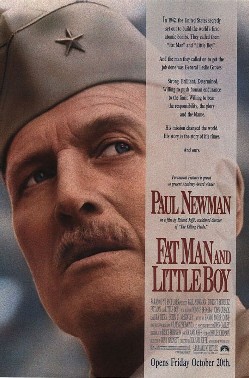
I should have written this blog last night, as it was the 75th anniversary of dropping the plutonium bomb on Nagasaki, Japan, which effectively ended World War II. Instead of writing about this, I watched the excellent movie “Fat Man and Little Boy” (1989), directed by Roland Joffé and starring Paul Newman. It details the creation of the Manhattan Project in Los Alamos, New Mexico, where top nuclear physics scientists are corralled in secrecy, racing to create the doomsday bomb before the Nazis do. It took only 19 months of intense, crazy pressure, and about $2 billion to create the first two thermonuclear weapons, used on Hiroshima (Aug 6,1945) and Nagasaki (Aug 9,1945). These remain the only times when nuclear weapons were used in war. It’s estimated over a quarter of a million Japanese died.

In the race to complete the bombs, scientists nationwide raised moral questions: should we even do this? At what cost in lives? The Nazis had surrendered by then and Hitler was dead; did we need to drop this on Japan? The moral questions were ultimately pushed aside in the quest to finish the project and end the war fast.

What made me startle was the dollar amount tossed out by General Leslie Groves, who headed the project: $2 billion in research. This is equivalent to about $28 billion today!

I thought about the costs estimated for gene therapy for hemophilia, estimated at $2 million per person. We all balk at this, but I also think about the amount of time, energy, expertise, investment and expectations that determine this price. Watching the Manhattan Project take shape and unfold in the movie, you’re amazed at level of intelligence of the scientists, the personal and professional sacrifices they make, the intensity of research. We see that happening now with a race to find a vaccine for COVID-19. What does it take, how long, and at what cost?

The bombs ended the war. Japan surrendered on September 2, 1945 in a humiliating defeat. Research that caused massive and sudden death and destruction for a final victory. The moral dilemma: was this research for good or for evil?

We’re now racing to defeat another enemy in war: COVID-19. Almost any cost is bearable, yet we are at odds with one another at what costs, and how much. The inconvenience of wearing masks? Laughable when we watch the sacrifices of those in World War II, or any war. Loss of livelihood? A serious sacrifice. Loss of life? No question. Any cost, any inconvenience.

In hemophilia, there was a time when we were at war, with HIV. We raced to find methods to kill HIV in the blood supply, and then to create recombinant products (not from human plasma). Now we have the luxury of time. Current standard factor products in the US are excellent, plentiful, accessible. Expensive, yes, but we have them. And we have ways to pay for them. Gene therapy will be a luxury product at first, and very expensive. It will be a challenge to convince payers to cover this, but we believe ultimately in access to all therapies. Freedom. As in war, so in medicine.

And no matter how you look at it or what the cost, it is still expensive research to cover, but research for the good.

Facts and Figures, Emotions and Reason

Facts: Who knew?

I don’t have many phone apps, but one I love is called Facts. Every day, I receive a unique fact in white lettering on a pretty background. The facts tend to be trivia, such as “A group of rhinos is called a crash.” Or, “Metallica is the first and only band to have played on all 7 continents.” (Who knew?)

Yesterday, the fact read, “We keep believing things, even when we know they’re wrong. Social manipulation can alter memory and extend the amygdala to encompass socially mediated memory distortions.”  

This message seems a dire warning of the dangers of social media. We all want the facts—truth. And the truth is hard to discern amidst a rampant pandemic that has so far killed over 154,000 Americans. My friends on Facebook want to make sense of what is happening, and in doing so, post and repost graphics and statements that seem contradictory at best, and dead wrong at worst. It reminds me so much of the years of the HIV epidemic, where fear took over common sense and critical thinking.

“Mathematics allows for no hypocrisy and no vagueness,” said the French writer Stendhal. Mathematics is said to be pure, logical, apolitical. But statistics… that is entirely different. Statistics uses math to reveal patterns and relevance. Statistics can be manipulated, presented in a half-light. Statistics can be used to support an argument, but can also be used to refute the same argument. Who to believe? And when you have a pandemic in an election year, with emotions running high, statistics are tossed about as truth. When I start seeing statistics and patterns of numbers presented on Facebook by my friends, I begin to wonder what they are trying to say or prove.

For example, one colleague in late April posted a chart from the CDC showing that the combined COVID-19 and pneumonia and flu deaths were about 94,000. She gloated that the CDC “lied” because there were not 94,000 dead from just COVID, as stated in the news, but that the total included other disease states. I politely questioned her statement, and pointed out that the current COVID death toll of 94,000 at the end of April was not the same as the 94,000 figure she was using. The CDC data she was using was from early April. In a matter of a few weeks, the death toll had skyrocketed. An easy mistake to make, but she was comparing incorrect numbers. Instead of thinking about this, she accused me of driving an agenda to match “my own narrative.” Yet, while I have not ever posted anything of a political nature on social media, that’s all she was doing on Facebook.

Many are now using statistics on social media to do just that, support a narrative, usually political. It makes me wonder if, during the HIV scandal years, if there had been such a contested election and polarized politics, would we be manipulating statistics so much and ignoring the public crisis? Would we tell people not to wear condoms as we now flaunt not wearing masks? Would we deny the number of people dying? We didn’t have social media then, nothing to fuel the flames of conspiracy.

Here’s another example that prompted me to write this blog:

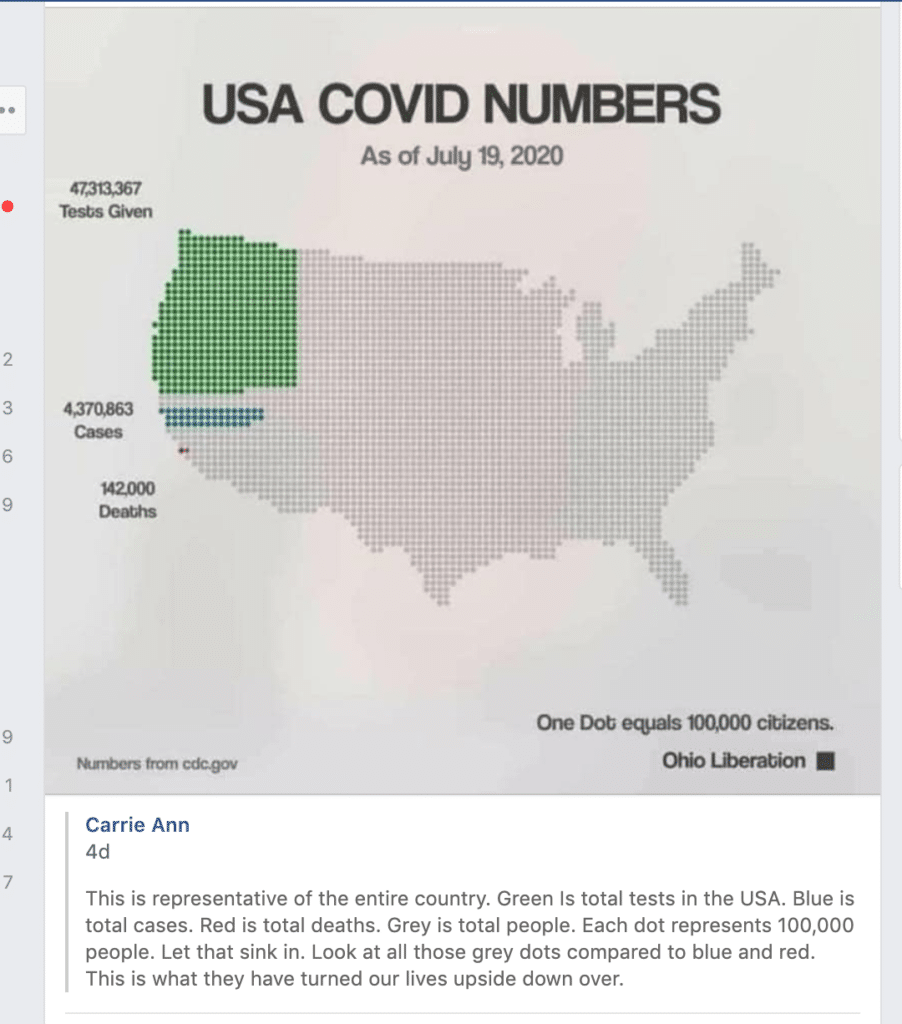
If you look at the dots on this map, such a “small” death toll does not seem too bad. The poster also insinuates that such a death toll is not worth “turning our lives upside down,” though she does not say what this means (simply wearing a mask? Or losing a livelihood?). Ask: what message is she trying to say? What could be misleading about this?

Now think of the HIV epidemic, which wiped out half of our community. We lost 10,000 people over a number of years. That would barely be visible on this map. One lone little grey dot. Yet, it decimated us. It led our community to advocate and this led to permanent changes in how blood is collected, tested and distributed, for the betterment of all.

And now think of this map from this perspective: with 1,000 Americans dying daily, it’s as if three loaded jumbo jets are crashing every, single day… for months.

What’s missing from Carrie Ann’s map is time. And this is important.  Here’s more perspective: 154,000 dead from COVID in four months is almost as much as the 157,000 dead in over 20 years of the Vietnam War. Top medical experts are now saying we could hit 200,000 Americans dead by fall. This is about one-third of all US deaths from HIV in the past 38 years.

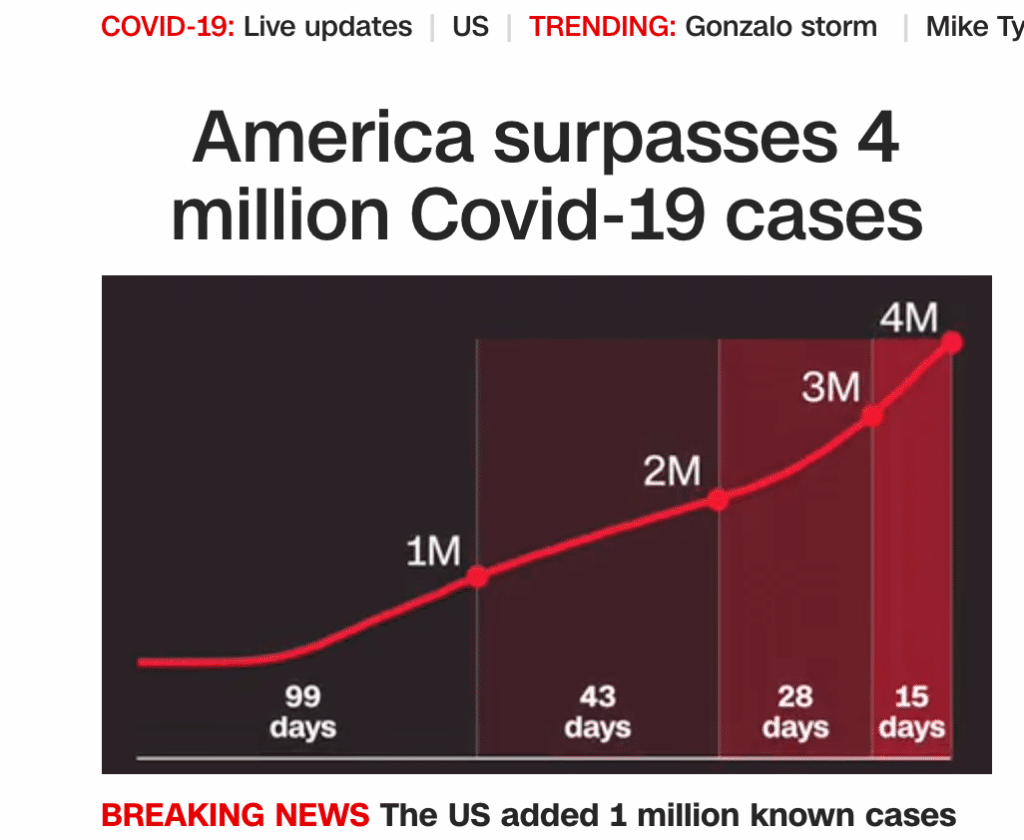
Now get away from a snapshot of a map, and look at trends below:

The virus is exploding exponentially in number of cases. And eventually, in number of deaths, until a vaccine is approved. Or not? Could it be that cases are exploding and will continue while the death rate might level off at some point?

So why do people latch on to a map, or one graph, or fail to compare, contrast, and critically review what is posted and reposted on Facebook or other social media?

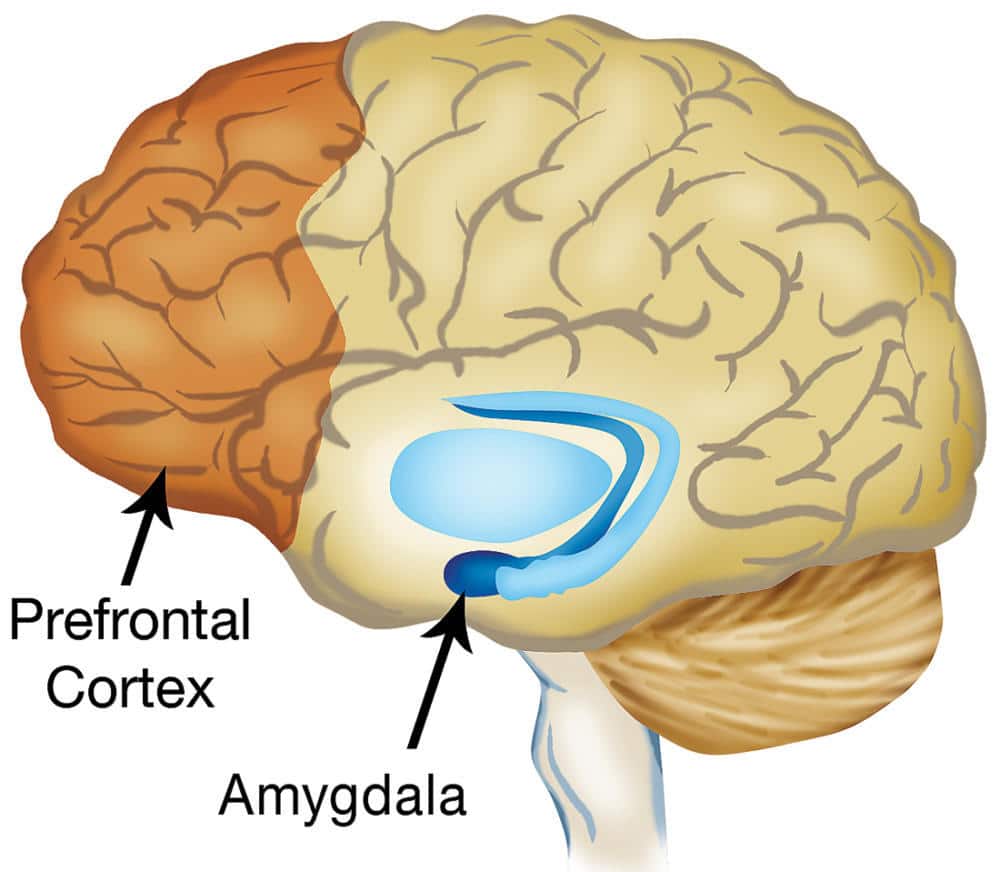
Perhaps it does has to do with the amygdala. The little organ in the brain responsible for the “fight or flight” reaction. The little organ that is considered the seat of emotions. It filters perceived and real threats from outside us, to help determine our next actions. Do we run away from danger? Do we stand and fight? We see political posts, and fearful posts about COVID, and we stand to lose our business or loved ones, or even our favorite elected official, yet we no longer can fight physically from a computer. Instead, we attack via posts. Whatever we do, it’s usually an emotional response.

What overrides the amygdala is the grey matter, the frontal lobe, the prefrontal cortex, the seat of reason. Far too many people seem to be allowing the grey matter to take a back seat. Instead, the constant barrage of posts on social media act like physical threats to us, and we react emotionally by twisting statistics or simply reposting something without stopping to ask: Is this true? Does this present facts in the right perspective? What is the source of the post? Are they credible? Could I be wrong? What is a better way to say this, or present this?

Rational response vs emotional reaction

Or more importantly: are my beliefs (political, religious) filtering the statistics and making me use them to support my beliefs or “narrative,” or will I allow the information to challenge my beliefs?

One community member posted this, which sarcastically challenged the statistics people had been tossing about, and put things in perspective:

Even if the fatality rate of children in school due to Covid-19 is “only 1%”, there were 56.6 million kids enrolled in school in the US last year. 1% of that is 566,000, or just slightly less than the population of the entire state of Wyoming. But it’s fine, right? It’s just 1%, right?

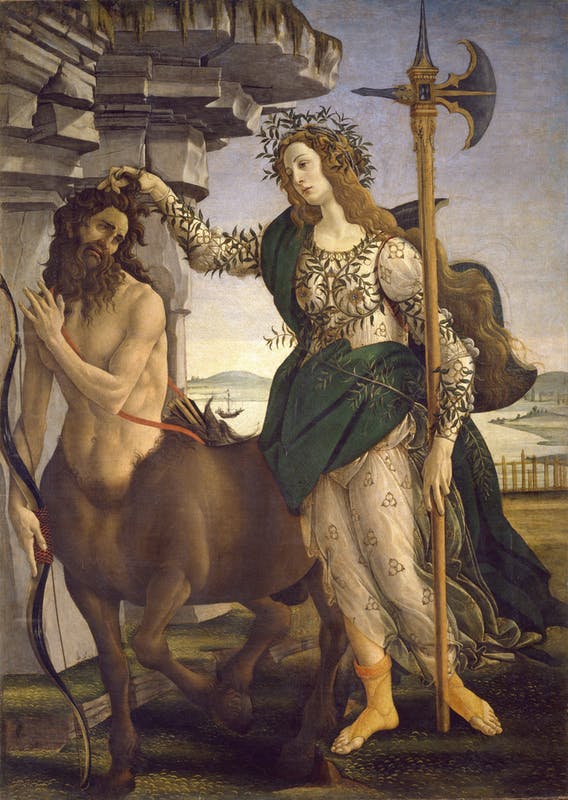
When you first enter my house, you may notice a framed picture hanging on the wall. It’s one of my favorites. “Pallas and the Centaur” by Renaissance artist Botticelli shows the Greek goddess Pallas Athena, goddess of knowledge and wisdom, with her hand on the head of a centaur. Her beauty and cleanliness is in contrast to the horseman’s hirsute body and tortured facial expression. The mythological centaurs were believed to be lusty, passion-filled creatures, all emotion. While there are many interpretations, I regard the painting as meaning knowledge and rational thought can and should override baser emotions, like lust, anger and hatred, for the betterment of humankind.

Maybe I’m just feeding my own narrative, but I think we could use more critical thinking when we use social media; more rational thought than emotional reactivism; and more recognition that one life does matter. It’s not all about statistics. Each of the 154,000 represents a loved one, and we still have time to save the other 50,000 or more in danger.

“If you can’t find the right answer, first you identify all the wrong ones”. -Joan Clarke, The Imitation Game

Hemophilia: A Woman’s Journey to Effective Treatment

by Milora Morley, MPH

©LA Kelley Communications, Inc. Reprinted with permission.

Publication: Pulse 9.19

I never thought at age 27 that I would begin a journey as a woman diagnosed with mild hemophilia A. My brother, as well as several men in my family, have all been diagnosed with severe hemophilia A. I’m no stranger to this disorder.

Milora Morley

            I grew up in the south Florida hemophilia community. As my brother’s keeper, and older sister, I had a lot of responsibility as a secondary caregiver. I knew about doctor appointments, factor brands, and clinical trials. But when the roles change, and you’re the one who may need caregiving…everything changes.

            I remember I encouraged my brother to be positive and live his best life. Hemophilia was not the end of the world! Now, here I am years later, feeling discouraged and defeated, as if hemophilia were indeed the end of the world.

            My personal journey has been difficult. Witnessing my brother’s experience made me hope that I’d also get the attention and treatment I need to move forward. But I was wrong. As much as health professionals may know about hemophilia, it seems that they know it only as it pertains to males. In my experience, the specialists aren’t always educated about this bleeding disorder, or maybe they truly don’t want to believe that a woman can have hemophilia.

A Surprise Diagnosis

In 2016 I lived in Atlanta, Georgia, and became my brother’s legal guardian; he had recently relocated from Miami, Florida, to complete his senior year of high school. During his transition, he lost Florida Medicaid and was also ineligible for Georgia Medicaid. He was left with no insurance.

            Later in the semester, he had a hip bleed. We rushed to the ER. Thankfully, the hospital social workers helped him receive emergency Medicaid, which covered his visit. While he was being treated, they suggested I have free genetic testing for parent or guardians, so I did.

            My brother wrapped up his final semester as a senior, and I moved to Los Angeles, California, in October 2017. In November my brother called, asking me to contact his nurse. When I called her, she explained that they had been trying to reach me for the last few months. I was in a bit of shock as she told me that I have a factor level of 38%—mild hemophilia A—and that I should register with a local hemophilia treatment center (HTC).

            I asked her what hemophilia looks like in women. I reflected on my past and current health issues, particularly my prolonged menstrual bleeding. At age 16, I began experiencing irregular menstrual bleeding due to abnormal hormone levels, but by age 22 my periods became more irregular and very prolonged. My menstrual cycle would stop for a day or two and start all over again; this went on for months. Doctors diagnosed me with pre-polycystic ovarian syndrome (PCOS), and started me on birth control right away.

            Before my hemophilia diagnosis, my ob/gyn refused to take me off birth control. We agreed that once I reached my weight goal, she would take me off so we could address the underlying issue of what was causing my PCOS or prolonged bleeding. I lost nearly 90 pounds to combat PCOS, and achieved my weight goal, only to have the doctor change her mind and tell me that I should just stay on birth control.

            I felt defeated. I eventually decided to stop birth control and explore my own options. By this time, I had already relocated to LA and had just received my hemophilia A diagnosis, but I was also having prolonged bleeding. I thought it best to start the journey with the mindset that maybe this bleeding was not just PCOS but also influenced by my new hemophilia diagnosis. So I connected with my PCP and decided to get back on birth control while I figured this all out.

            My PCP sent a referral for me to be seen by the local HTC in LA. However, my insurance denied it, as well as the appeal, due to “lack of medical necessity.” At this point, I didn’t have many options, so I figured I should see an in-network specialist.

“Women are just carriers”

On April 5, 2018, I had my first appointment with an oncologist who supposedly had experience treating patients with hemophilia. I told him about my strong family history and that I thought hemophilia could possibly be the real cause of the menstrual issues I’d been having, and not PCOS, as stated by past physicians.

            Although he had received a copy of the official diagnosis, the oncologist told me that it’s unlikely for women to have hemophilia, and that women are just carriers. He suggested I be tested by a lab that he trusted. He also suggested I have an ultrasound performed to look at my ovaries. I complied.

            A month later, I returned to this doctor, who said, “Your results came back, and you have mild hemophilia A.” This was now my second diagnosis. He told me that I needed to book another appointment in three to four weeks for him to give me a plan for treatment.

            Feeling a bit frustrated, I asked, “And what about my menstrual cycle?” The doctor acted confused, as if I’d never talked to him about my irregularities and PCOS. He told me nothing could be done about my irregular bleeding. I asked him, “Aren’t you alarmed that I have prolonged bleeding when off birth control, and isn’t that a symptom of hemophilia in women?”

            He then became defensive, and I became even more frustrated because two things became clear: First, the doctor hadn’t listened to me during my first visit, due to his assumptions about women with hemophilia; nor had he properly prepared for my visit. When diagnosing me, he spoke as if we had never discussed my family history of hemophilia, or any of the things I’d brought up.

            Second, the doctor had never had a female patient with hemophilia. When I asked if he would be open to consulting with Hemophilia Foundation of Southern California or the local HTC to determine a treatment plan for my menstrual cycle, he declined, stating that he could do his own research. I left the office in tears and didn’t feel comfortable returning to this doctor. I was still left looking for answers.

            In November 2018, I switched insurance plans through a new employer and tried the process again. This journey to finding the underlying issue is important for me. My new PCP, who was also a hematologist, admitted that he didn’t think he’d be the most suitable hematologist for me because he was out of practice in that specialty and not familiar with women with hemophilia. He asked me what I wanted to do, and I said I wanted to go to the local HTC. He agreed to send in a referral through our medical group.

            Again, my referral to be seen by the HTC was denied by insurance because they believed they had specialists more than capable of providing me the care I needed in-house. I obliged once again, and decided to see a specialist they referred me to in-network. But this time I was a bit more optimistic, because the specialist was a woman and this was one of the best health systems in greater LA. There was no reason I wouldn’t be able to find the care I needed…right?

            I was excited to meet this new specialist on January 7, 2019. She was an oncologist, but she also had experience with bleeding disorders. However, what this really meant was that she was experienced with treating women with von Willebrand disease (VWD). During my first visit, she suggested that my factor levels be tested once again. Although I had provided two prior diagnoses, I agreed. This time, my third diagnosis came back with much lower levels—23%. Most likely, this was due to no longer being on birth control.

Breakthrough

I really wanted to work with this specialist to figure out the best options for me. A friend of mine connected me with the Women’s Bleeding Disorder Coalition, which helped educate me about what hemophilia looks like in a woman.

            I thought it would be a good idea to connect my new specialist to the coalition. Surprisingly, she agreed, and I thought, wow, this is great! They provided my specialist with more information on hemophilia in women. I was happy and excited to hear that my specialist had taken that step on my behalf.

            But during a follow-up visit, I was taken aback when my new specialist (who I had been bragging about) made comments invalidating the information that was shared with her through the Women’s Bleeding Disorder Coalition, because they weren’t “medical professionals.” I was crushed.

            Sadly, I left that appointment with no treatment plan to address my menstrual bleeding, and the only medication offered to me was one most commonly used in women with VWD. Here we are, April 2019, and I still have irregular or prolonged menstrual bleeding. I’ve been fortunate to see an endocrinologist, who has been working very hard to determine my underlying issue. But at this point, he can’t pinpoint the actual cause. The reality is that he is not a hematologist, so he can’t help me access factor and attempt a trial treatment to determine whether my prolonged bleeding is in fact hemophilia.

            I have also been working with Hemophilia Foundation of Southern California to get access to the GHPP (Genetically Handicapped Persons Program) insurance, which would cover my visits to an HTC. I am currently awaiting a decision and crossing my fingers for a positive outcome. Now, at 28, I just want answers. I just want to know what’s the true culprit behind my prolonged menstrual bleeding, and what I can do to control it.

            I hope that one day, it won’t be so difficult to be connected to a doctor or specialist who really knows hemophilia in general and how to treat women with hemophilia. I also hope that soon, women will have the option to be seen at an HTC as opposed to being forced by insurance companies to see an oncologist.

            Women all over the world are gaining a voice through social movements and in politics. It’s time for the medical field to give us a voice—and answer, as well.

Milora Morley lives in Los Angeles, CA. She is employed as a business data analyst for Cedars-Sinai Medical Center. She uses her free time productively, as a small business owner of Paramedical Tattoo Services.

HemaBlog Archives
Categories