Laurie Kelley

Wild Child

Remember the 2014 movie “Wild”? About a woman, self-named “Cheryl Strayed” (as in strayed from the path), who decided to hike the Pacific Crest Trail from California to Oregon, a journey of 1,100 miles. Recently divorced, her life in emotional tatters, the trip is supposed to help her figure out who she is and where she is going in life. With no hiking experience at all, the journey is filled with danger and discovery. The movie received positive critical reviews.
Free Will: William Addison

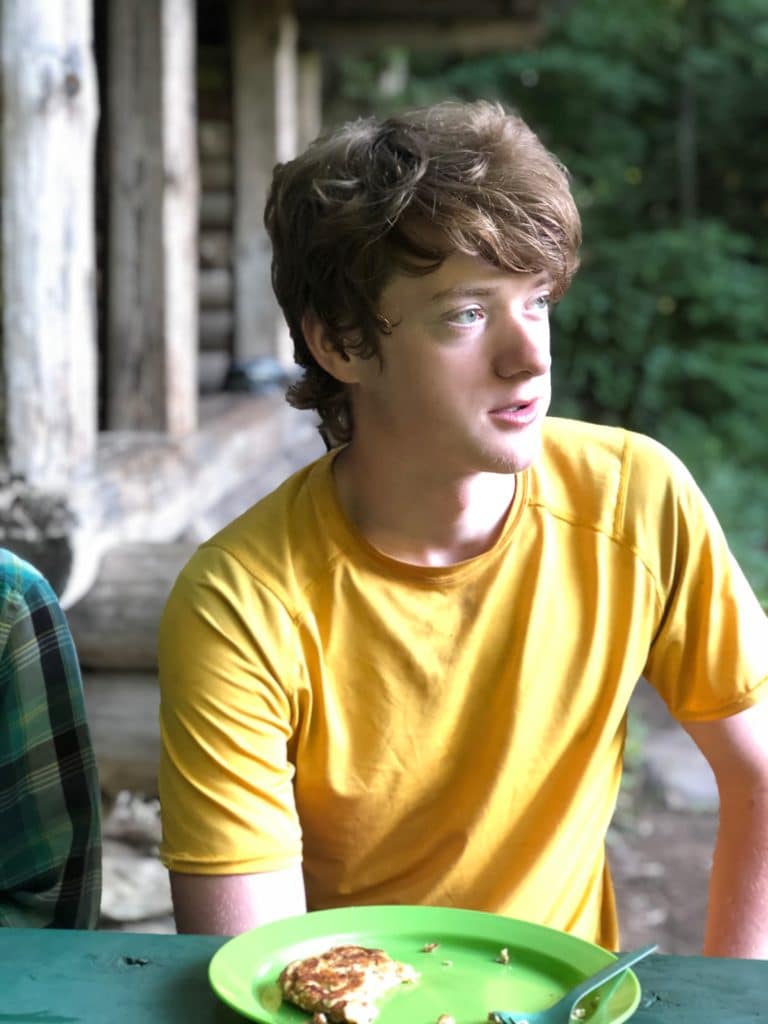
I was reminded of the movie this weekend after driving to Connecticut, to a trailhead on the Appalachian Trail (AT), to catch up with a young man with hemophilia who is now undergoing his own “Wild.” Will Addison is hiking 2,200 miles, southbound (“SOBO”) from Maine to Georgia, to raise money for the nonprofit I founded, Save One Life. That in itself is astounding. But consider this: he is not even 20, and is traveling solo.

Doug and I arrived at the trailhead around 5:30 pm, and immediately saw members of our local community, there to cheer Will on. Then Will’s parents arrived, David Addison and Victoria Kuhn, and their daughter Grace, Will’s twin sister, all from Maine. These are true outdoors people, who love camping and adventure. They came fully prepared to restock Will with food and supplies.

For Will, this was day 44, and mile 718. We parked by the side of the road, waiting for Will to appear.  There were freshly baked chocolate chip cookies from Victoria, beer, and lots of laughs. Some of us came equipped to camp overnight with the Addison family, and to see Will off in the morning. We learned from Victoria that Will would not arrive till about 9 pm, or later, so we decided to hike the 1.5 miles on the AT ourselves to find the camp site, and to set up camp. It was a lovely hike in the 90° heat, shady and moist. My biggest fear was the plethora of Virginia Creeper everywhere lining the trail. I am highly allergic to this plant: even a brush of it against my skin will leave a rash like a second degree burn for two straight weeks. And I was wearing shorts!
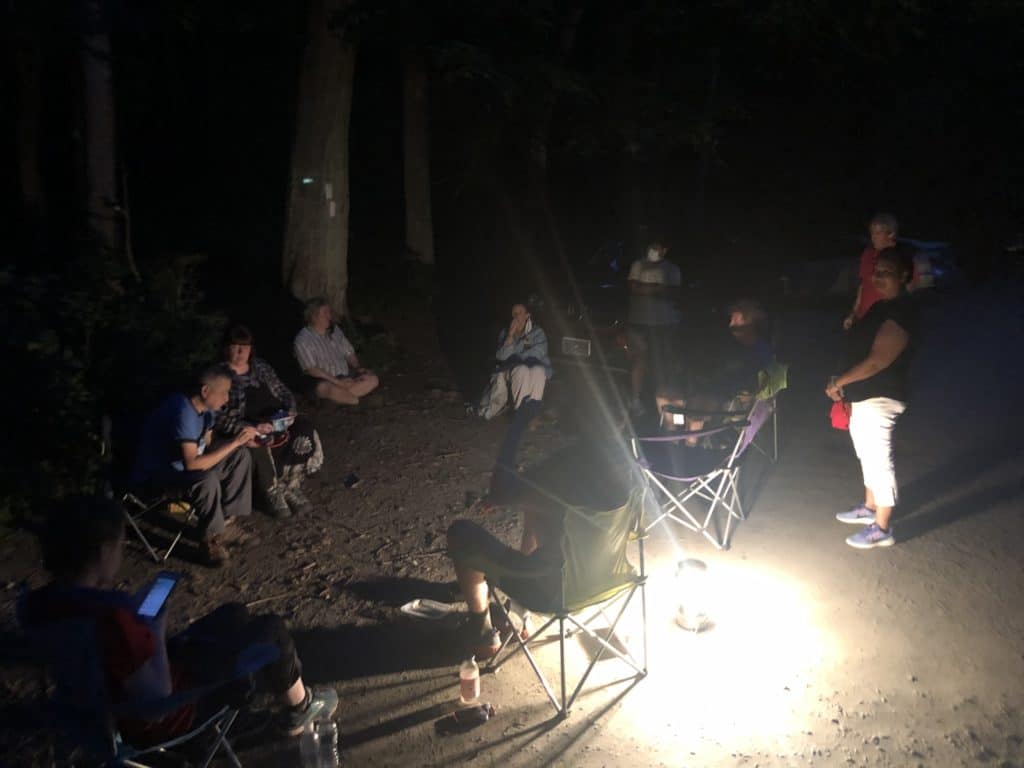
Bleeding disorder community waits for Will

Once at camp, we quickly set up tents, spread out our sleeping gear, and then hiked back again to wait for Will.

Around 9:30 pm, as we milled about, watching the magical and mesmerizing green flashing lights from the multitude of fireflies deep in the woods, out of the forest, out of nowhere, came Will! He literally burst into our little latern-lit gathering at the edge of the woods as if it was just a little stroll; in fact, he had just completed his longest day, at 28.5 miles. Just imagine… while carrying a pack weighing about 30 lbs.

He looked great. He is tall—6 feet 1 inch—with blond hair growing longer by the day, serene brown eyes, and lanky legs. He immediately sat down and began eating! We had a lovely visit with him and the community members, who peppered him with questions about his trip so far. Victoria, ever resourceful, brought a Save One Life sign, and we took a group photo. And we all signed his banner, which he is bringing with him to Georgia, the way Chris Bombardier did when he accomplished each of the Seven Summits. This sounds like a trite thing, but when you are limited it what you can carry, and you are traveling for 105 days solo, every ounce matters. It’s a huge display of respect and commitment for Will to carry the banner.

Hiking to camp

We had cheesecake in honor of a milestone birthday for the twins, just two days before!

By 10 pm we had to call it a day. The visitors drove off, and the final team hiked to camp: Victoria and David, daughter Grace and son Will, Doug and I, and Paul, father of a son with VWD. Now it was dark, with fireflies twinkling like little green stars above, so we used our headlamps to light the way on the trail.

Once at camp, we stuffed our food into a bear box, then quickly got to sleep in our sleeping bags on the ground in the woods, serenaded by the hooting of a barred owl that eventually flew off in search of prey.

Morning came fast, as birds lit up the woods in chorus at 5:30 am. By 7 am we had packed everything and readied for breakfast. Will showed me how to use my “Pocket Rocket,” a gas-powered cooking device. As I am a danger in a normal kitchen with a gas stove, this 5-inch device that looked like a little bomb scared me to death. But Will was a good teacher: I boiled water for tea successfully.
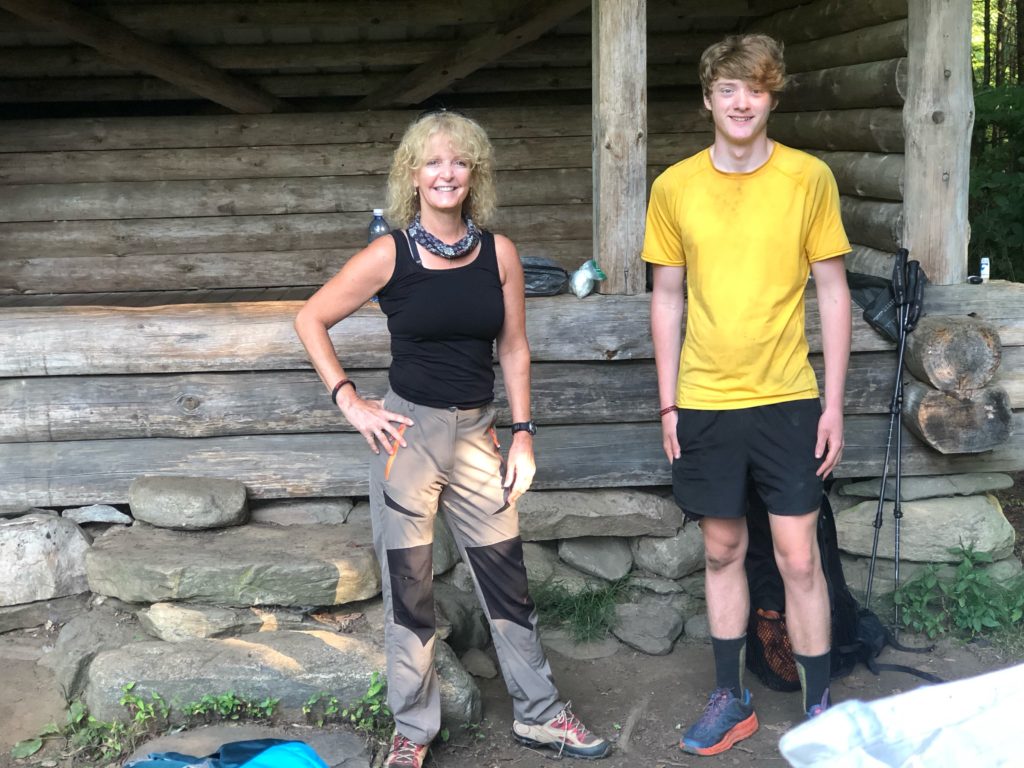
Laurie Kelley and Will Addison: sharing a love of hiking and contribution

This was a great time to ask Will about his journey so far. He is young, only a teen, but mature beyond his years. Still, where and how did he get this idea and ability? He is an athlete, participating in track at school, and soon to start cross-country track. He is a Boy Scout, “Third generation!” Victoria proudly added, a program which no doubt has provided him with the training and skills needed to camp out for 105 nights straight, and get him all the way to Georgia. He infuses often, every other day, to ward off bleeds. He has zero body fat (and lost about 10 pounds on the trail so far) but has muscle tone, so he is in excellent shape. He has an outdoor-oriented family, so the woods are not new to him. He seems to thrive in them like a true wild child!

He’s raising money and awareness for Save One Life, our international child-sponsorship organization. Why Save One Life? He wanted to make a difference in the world, beyond the borders of Maine, his home state. I sense he wants adventure in the great, wide world too. Perhaps one day Will and I will climb Kilimanjaro together, and he can also see our families in Kenya and Tanzania, how they struggle and how much they need our help. His eyes lit up at this idea.
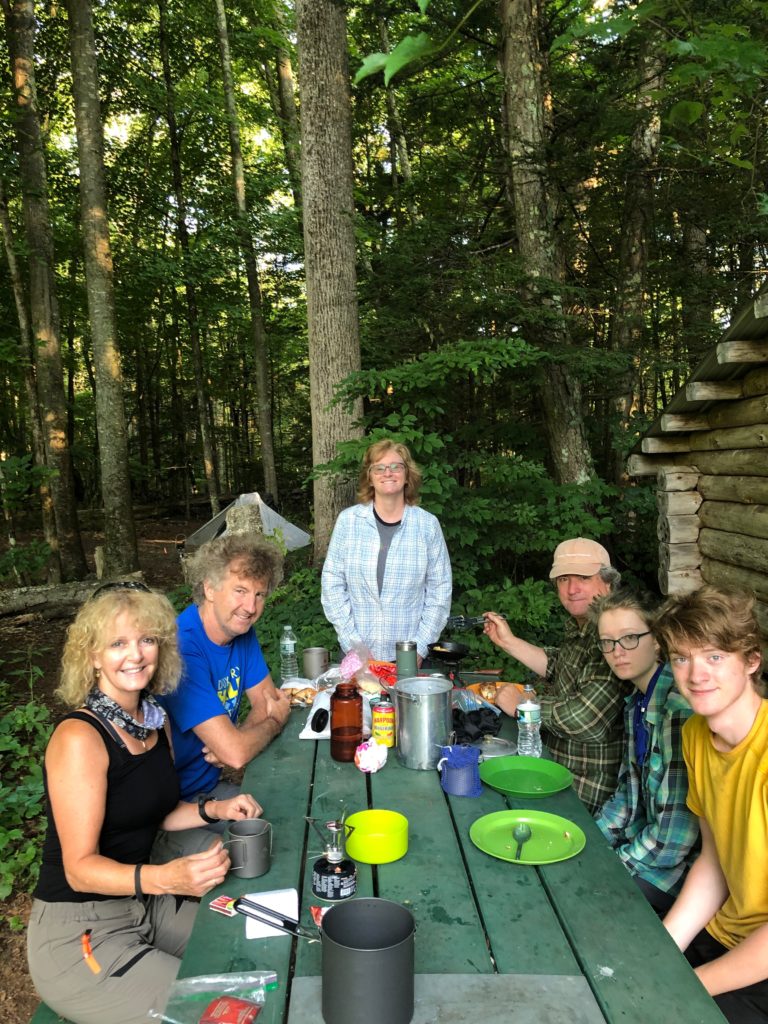
Breakfast in the wild

Will spends most days alone on the trail, quiet, thinking, listening to music through his iPod. It can be lonely. He is only a kid, really. How does he keep it together? My most important question was this: what have you learned about yourself these past 45 days?

He thought for a moment, while munching on a baguette. “I think I’ve learned that I am more independent than I thought I was.”

Powerful statement. As parents of children with hemophilia, we want our children to be independent. This might be an extreme example, but a teen who can hike an average of a marathon each day for 105 days solo, while needing to infuse every other day, is beyond impressive. It’s stunning. He needs abilities like discipline, goal setting, planning (“He planned everything himself,” Victoria adds), preparation, focus. Independent? More than most adults I know. This young man, William Addison: watch for him. Donate to his hike’s cause, Save One Life (he wants to reach $10,000!). Follow him on Facebook. Learn some things from his amazing journey. He’ll be hiking till September.

William Addison is the type of young person we want to see more of in the world–with or without hemophilia. He is the future… I hope, with all my heart.

Wild child, full of grace, savior of the human race…. “Wild Child,” The Doors, 1969
Mental Health During Coronavirus

Debbie de la Riva

The collective pursuit to control the spread of coronavirus has resulted in an enormous challenge for the bleeding disorder community. The economic fallout of sheltering in place has affected our need for a steady income, health insurance, access to medical treatment, and—equally important—our access to each other. The degree of impact on our families is hard to determine, but it’s safe to say this pandemic has been very stressful.

But stress in not a new concept for the bleeding disorder community. In fact, our community has been dealing for years with the emotional angst of fighting for what is needed to manage our medical conditions. Remember our fight for safer products, or our fight for laws to protect us from job discrimination? Today’s battle, for our community, is to deal with the stress resulting from the pandemic. So let’s follow the same steps we have taken so many times before.

Let’s get informed, find our resources, and stick together.

Get Informed

To learn to manage stress, we need to become familiar with how our central nervous system works. Our brain comes pre-wired with an intricate system that functions to keep the rest of our body alive. This is the limbic system, which provides the “fight-or-flight” response. If the brain determines that the body is in danger, it initiates a chemical chain reaction that gets the body ready to either fight the challenge or run from it. This response begins when sensory information is picked up by a part of the brain called the amygdala. If the amygdala determines there is a threat, it signals other parts of the brain and body to release hormones such as adrenaline and cortisol. These hormones instruct the heart and lungs to increase their output in order to create the energy needed to meet the challenge. This fight-or-flight response is extremely effective when a person needs physical energy to avoid a danger such as jumping out of the way of a car.  But most of today’s challenges are emotional, and they don’t require the extra energy provided by the stress response. The result is a steady supply of stress hormones circulating in the body at all times. The image that comes to mind is a person standing next to an IV pole and steadily receiving drips of adrenaline and cortisol. In others words, our body remains in a constant state of high alert.

The good news: We do have the ability to slow down the stress response. Since we now know that the brain is constantly scanning our body and our environment to determine if it should go into stress or relaxed mode, we can intentionally offer cues to indicate that we’re not in danger. In fact, this is how meditation works. The first goal of meditation is to slow down your breathing rate. This is important, because once your brain receives the signal that your breathing rate is lowered, it will interpret this to mean that you’re not in danger, and will turn off the stress response. The second goal of meditation involves your focus. You want to be focusing on the present—instead of musing about the past or anticipating the future—and you want to intentionally focus on words or images that evoke feelings of peace or happiness.

You can bring up images of when you felt safe and happy, or you can think of words that reassure you. This tool is like anything else in life: it requires practice and commitment. But eventually, you’ll find that you can truly create a sense of well-being, no matter what’s going on in your life. Sound too good to be true? Do you need proof? Ask yourself how you feel when you’re watching a scary movie, and compare that to how you feel when you’re watching a romantic comedy. In other words, what we focus on creates how we feel inside. That same principle is at work when we intentionally think about what we are grateful for, as opposed to what we lack or what we don’t like about our lives.

Learning to handle stress is more important than ever. Let’s look at the many resources that have been created since the coronavirus pandemic started.

Find Resources

National Hemophilia Foundation (NHF) and Hemophilia Federation of America (HFA) have created content to help people in the bleeding disorder community deal with both physical and emotional impacts of the pandemic. The following links will take you to the current web pages with this information.

National Hemophilia Foundation

hemophilia.org/Newsroom/COVID-19-Information

Hemophilia Federation of America

hemophiliafed.org/news-stories/2020/04/coronavirus-covid-19-what-hfa-is-doing/

You can also purchase proven self-help workbooks on stress reduction at New Harbinger Publications: newharbinger.com

And yes, there is an app for learning to relax! Appropriately called the Calm app, it has hundreds of meditations and master classes on stress management: calm.com

You can find these resources and many others by visiting the Mental Health Matters Too website: mentalhealthmatterstoo.com

Seek Out Others

It didn’t take long for our community to figure out how to be connected virtually. Though it isn’t the same as being in a room together, it is nice to see familiar faces and get a chance to let someone know you are there for them.

Take a moment to check in with yourself, because it’s very easy to feel lonely in isolation. If you find that you’re exceptionally lonely, depressed, or anxious, it always helps to talk to someone trained to help you feel understood and supported. Online platforms like Talk Space and Better Help are reporting an exponential increase in the number of requests for counseling sessions right now.

Look for Purpose

One of the best ways to combat the feeling of helplessness that comes with a crisis is to look for a way you can help others. This sense of purpose gives people some control, and helps them feel productive and useful. For me, contributing to Save One Life is one way I fulfill my need to have purpose in my own life. Each month, I have a small sense of satisfaction knowing that there are three young people with hemophilia who feel that someone else on this planet sees them and cares about them.

So, whether it’s meditating, talking with someone, or just being there for another human, there are ways to combat stress. We will get through this pandemic as a community, the way we always have. We will get informed, find resources, and seek out each other.

Debbie de la Riva, LPC, has been an active member of the bleeding disorder community since the birth of her son with severe hemophilia 25 years ago. She served as executive director of the Lone Star Chapter of NHF, was a co-chair of an NHF Annual Meeting, received a Ryan White Award for Advocacy Excellence, and has presented on mental health issues to chapter and national organizations. In 2018, Debbie founded Mental Health Matters Too as a way of combining her degree as a licensed professional counselor with her passion for helping community members who struggle with mental health challenges. To contact Debbie: www.mentalhealthmatterstoo.com or debbie@mhmtoo.com

Red, White and in Two

The topic of flags has been in the news a lot lately, and with the Fourth of July weekend ending tonight, it got me thinking of our flag. It’s the main symbol of any country, and deeply personalized and personal to each country. It’s used to represent a country in times of peace at international conferences and meetings; and used to unite a country in times of war, to rally the troops and display on ships and aircraft. Americans love to wave the flag and refer and defer to the flag, even when we are as deeply divided as we ever have been since the Vietnam War. A foreigner visitor staying with me once said that they had never seen any country that had so many flags posted in public as the US.

The symbols on a flag are carefully chosen, as are the colors. Look at the color red, for example. The bleeding disorder community does not have a flag per se, but we use colors and symbols as our “flag,” to unite us: the red figure and the “empty” figure. I hesitate to write white, even though the figure appears white in color, because the figure really represents a figure devoid of blood, of factor. Many years ago the logo was of a white figure leaning on the red figure, showing dependency. While this is still the case for a lot of countries dependent on factor donations, the World Federation of Hemophilia wisely chose to change this to two upright figures, to show unity, support and hopeful equality.

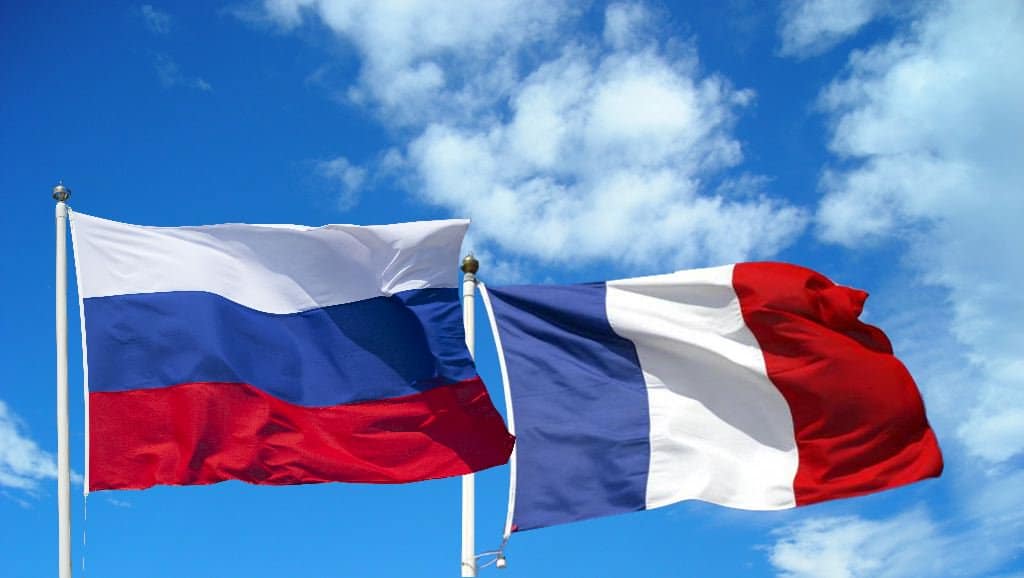
Red is used in many flags to depict blood, or more appropriately bloodshed, for that spilled when a country was formed. And white is often used to denote peace. Red, white and blue is the standard for republics: France, Russia and the US all have common looking flags with the bold tricolors.

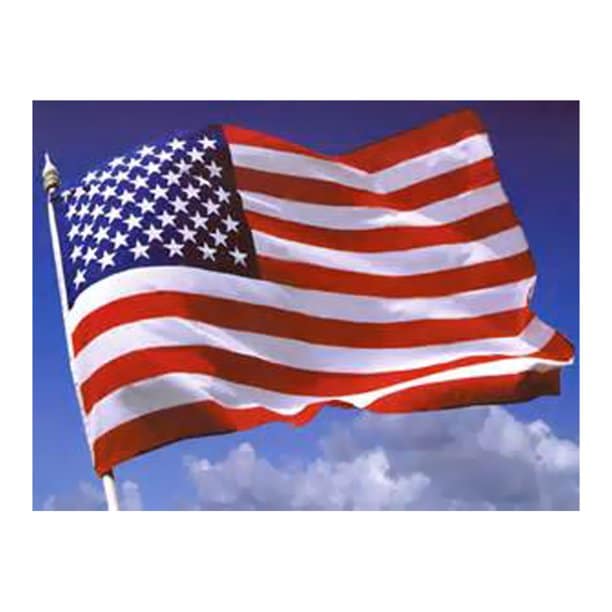
But these colors may have a different meaning for the US flag. From pbs.org: “Thee stripes represent the original 13 colonies and the stars represent the 50 states of the Union. The colors of the flag are symbolic as well; red symbolizes hardiness and valor, white symbolizes purity and innocence, and blue represents vigilance, perseverance and justice.”

It’s hard to know what the colors mean in reality now. The nation is torn politically, reeling from escalating COVID-19 cases, back to quarantine and lockdown for some states, and economically teetering. We are showing our true colors under the stress. When I think of hardiness and valor, I think immediately of the medical teams at ground zeros, working day and night to keep people alive. And while they struggle to do this, a nation burns and yells and topples statues. Purity and innocence seem lost. And justice is being questioned daily.

But not that long ago, the hemophilia community was also torn in two. The HIV scandal caused a deep divide when we learned that so many knew that HIV was or might be in the factor being injected into our young men, and kept that knowledge or concern hidden for the sake of profit. The community launched a severe backlash against the national foundation, which was to be our watchdog, which we trusted; the community as a whole eventually launched a social and legal assault on the government, which ignored our plight for too long, and on pharmaceutical companies. We didn’t have social media then, only our voices and feet, to march and speak out. This community united and changed history, and helped save the lives of thousands.*

Sadly, America has a ways to go before we will be united and eventually healed. But it will happen.

And what about the stars and stripes? A book about the symbolism of the American flag published in 1977 by the House of Representatives reads (from colonialflag.org):

“The star is a symbol of the heavens and the divine goal to which man has aspired from time immemorial; the stripe is symbolic of the rays of light emanating from the sun.”

Sober things to reflect on this holiday. Perhaps we can think of the flag colors red and blue as denoting the two chief political parties… and white, to denote peace, a peace we want, need and can not seem to achieve just yet.

*Watch the excellent documentary Bad Blood, by Marilyn Ness

The Hemophilia Community: Unmasked

Last night Doug and I watched the 2019 movie “Midway,” which had spectacular CGI aircraft battles. We somberly recognized the extraordinary sacrifices made by the young men who served. This after we also watched the Ken Burns’ series on Vietnam on Netflix. Different eras, different situations but what remains constant is the incredible sacrifice of Americans to serve and protect fellow Americans.

Which is why it’s hard for me to comprehend why some Americans are resistant, almost militant, to wearing a mask in public to protect against coronavirus. Even more, why anyone in the hemophilia community would resist. Of all people, we know what it’s like to be caught in an epidemic, to be victims of public health breaches. We’ve had horrific sacrifices, and those of us who escaped HIV by a year or so are forever grateful and respectful to those who lost their lives.

But lately on Facebook some hemophilia colleagues questioned what good would wearing a mask do, and others defiantly claimed they would not wear one in public. “I’m an American,” one woman wrote; she had worked for a hemophilia specialty pharmacy. “It’s my constitutional right not to wear one.” This, in white letters on a screaming red background. Another, an industry rep in Florida, wrote that he didn’t know anyone with COVID, thought it was overblown, didn’t see any difference in life in his corner of the world, so he was not going to wear a mask in public.

Beyond the actual act of going in public without a mask was the “unmasked” attitude: I’m an American and I’m doing whatever I want.

This led to a barrage of replies and comments about what it means to be an American, especially that it’s not always “about you.” The woman replied, “You do you and I’ll do me.” An extremely selfish comment to make during a pandemic, with over 125,000 Americans dead in a few months (more than twice the number that died in nearly two decades of fighting in Vietnam).

I kept thinking about our Hemophilia Holocaust. HIV is much less contagious than COVID. You can only catch it in certain ways. COVID is incredibly contagious. Yet during the HIV era, you did not hear from people screaming about their rights to do what they wanted, and not be inconvenienced by taking precautions. It made me wonder, what if we substitute the word mask with condom?

“I’m an American and it’s my constitutional right not to wear a condom if I don’t want to!” True, but what do you risk? Disease, unwanted pregnancy, spreading disease to others. Spreading the disease to babies. You never hear anyone talk like that about condoms. Why are we even applying constitutional rights to something that is about protecting public health? This was never done before. Is it because it’s an election year? Has politicizing a public health crisis changed the way people view public health now?

Well, Florida is now being considered an epicenter of COVID-19. It had almost 10,000 new cases in a single day, the highest in the country. Florida is going backwards, because it reopened, and people did not take precautions. A good friend of mine there took advantage of the reopening, got together with her family for the first time in months at a restaurant for just a couple of hours. Almost everyone got COVID, and some are very sick. She has completely changed her mind about wearing masks; it’s now imperative.

And 36 states have escalating cases. My state, Massachusetts, is holding steady, but we should be declining, with all that we know about this virus. Look at New Zealand: it’s considered virus free now, because it locked down, people wore masks and social distanced, and they united as a country to fight this common enemy.

Why is America now the leading country with the highest number of cases of COVID? Because so many are not taking precautions, like wearing a mask. A simple sacrifice that certainly does not infringe on any of your freedoms. It’s a lot less inconvenient than using a condom. And the simplest of sacrifices compared to those who fought–and died–for our freedom.

To be an American to me means honoring the sacrifices made by those who died protecting our freedoms: in World War II, in Vietnam, the doctors and nurses who have died recently, the patients and yes, babies, who have died. Remember the famous words: It’s not about what your country can do for you, but about what you can do for your country. Wearing a mask protects you, but it’s not about you. It’s about protecting others, stopping the spread. Sacrificing a slight inconvenience to help preserve the common good. Uniting and adopting known ways to stop the spread of this virus. With the freedom and rights of being an American come responsibilities.

What does it mean to you to be an American in a pandemic? What have you learned from the HIV holocaust? What can you do to stop the spread of this insidious virus? Some things to really ponder over the upcoming fourth of July weekend. Appreciate what our medical community is enduring as more people require hospitalization; empathize with those who have lost loved ones. Watch “Midway,” “Pearl Harbor” or some other good war movie. You will see what real sacrifice is, and what being an American really is about.

Politics and Pandemic

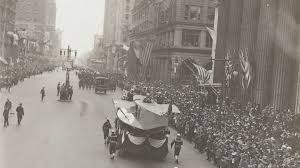
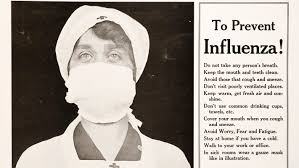
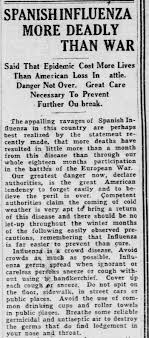
Watching the rally in Tulsa, Oklahoma this past weekend makes for a chilling comparison to 1918. Current concerns about crowding and COVID-19 were fears about the Spanish influenza then. And like the political rally in Tulsa, Philadelphia hosted a huge parade, politically motivated, to attract thousands of people, even though the city was besieged by the pandemic. This influenza was virulent, hostile and swift. Why was a parade scheduled?

Parade of September 28, 1918

Politics… squelching the voice of science, muzzling the press, and placing political agendas above the safety of citizens. In many ways, we are facing similar challenges, with a public unsure of who to believe. The government? The scientists? The press? In 1918, schools, churches and businesses were shut. People wore masks and practiced social distancing. But it was also wartime, and the drafting of so many young men and crowding them into barracks and hastily made tents during the previous winter helped spread a virus that would kill four times as many Americans as soldiers in the World War II–the Great War.

John M. Barry, in his book The Great Influenza, describes a Philadelphia in 1918 as a steamy, overcrowded city of 1.7 million, with slums. A breeding ground for epidemics.  And for political machines: corruption was as widespread as the virus.

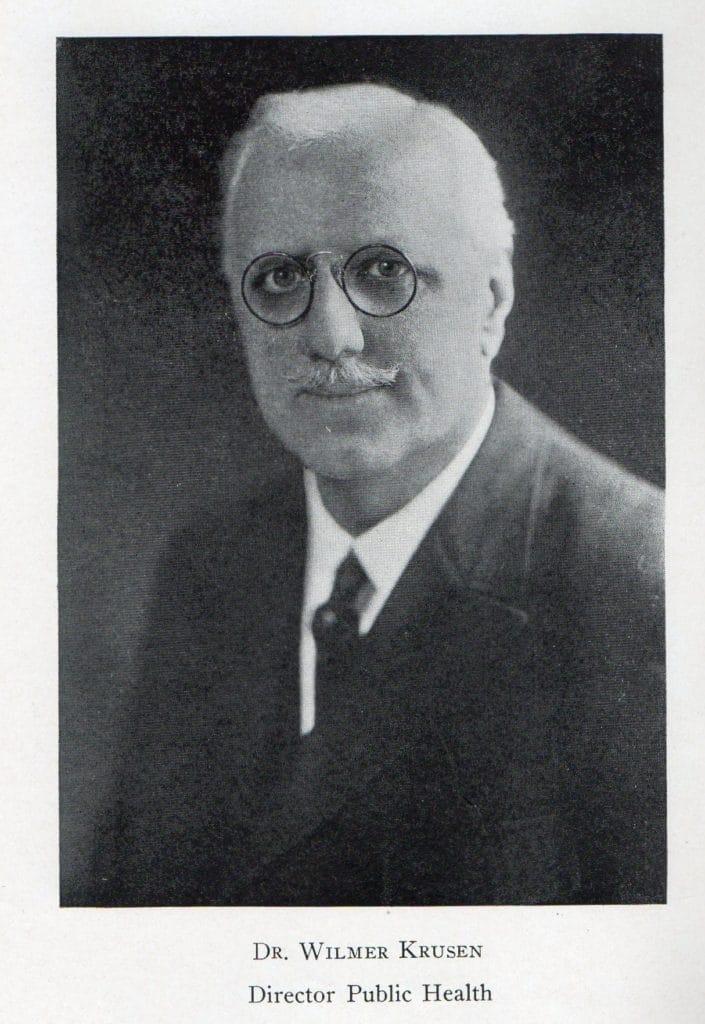
On September 7, 1918, 300 sailors arrived from Boston, where nearly 1,000 had already died. Philadelphia Public Health Director Dr. Wilmer Krusen did not quarantine the sailors. He announced that the ones who died did not die of influenza.  Why would he deliberately lie? Philadelphia had a quota to sell so many Liberty Bonds, to raise money for the war effort. The parade would kick this campaign off. Local doctors urged Krusen to cancel the parade. Influenza was spread in crowds.

By September 15, the virus had made 600 sailors sick enough to be hospitalized. On September 17, 5 doctors and 14 nurses in that same civilian hospital took ill. Krusen publicly denied that influenza posed any threat to the city, feared that taking any such steps might cause panic and interfere with the war effort. The parade went on.

Two days after the parade, Krusen announced, “The epidemic is now present in the civilian population.” Krusen, a political appointee, failed in his role as doctor and health commissioner.

All over the country, as young men gathered to report for war, they fell ill. Dr. William Welch, brilliant head of a new committee to handle the pandemic, wrote to the army to quarantine the new recruits. He knew that one of the best measures to stop contagion is avoiding crowding.

Most army officials ignored the warning. On August 8, a Col. Hagadorn took over Camp Grant. He allowed overcrowding. In six days the hospital went from 610 occupied beds to 4,102. From there, 3,108 troops took a train to Georgia—where 2,000 arrived ill. On October 8, Hagadorn committed suicide.

In Philadelphia, just 72 hours after the parade, every hospital bed in Philadelphia was filled with sick people. Nurses were dying. Corpses lay about everywhere.

But politics still overshadowed the truth. On October 5, doctors reported that 254 people died that day from the epidemic, and the papers quoted public health authorities as saying, “The peak of the influenza epidemic has been reached.” Then 289 Philadelphians died the next day, and the next day 428 people died. Dr. Krusen said, “Don’t get frightened or panic stricken over exaggerated reports.”

47% of deaths in US now were from the Spanish flu.

The civilian health care system was in trouble, as the government took as many doctors and nurses as possible for the war effort in Europe. Lab animals were unavailable for testing vaccines. Masks, protective gear was scarce. Everything went to equipping the war machine.

And politics went on. Back on January 1,1918 Tammany Hall regained control of New York City. Patronage determined jobs but most jobs in the Department of Health were not patronage positions. No problem. Tammany began to smear the best municipal health department in the world. Division chiefs were fired, and highly respected physicians on the advisory board were removed. The new health commissioner, Royal Copeland, was dean of a homeopathic medical school, and not even a doctor of medicine! Perhaps he was appointed because the bosses knew he would not cause trouble. They were right.

“The best municipal public health department in the world was now run by a man with no belief in modern scientific medicine and whose ambitions were not in public health but in politics,” writes Barry.  

On September 15, 1918, New York City’s first influenza death occurred. Commissioner Copeland assured the public “that the disease is not getting away from the control of the health department but is decreasing.” Eventually, the death toll reached 33,000 for New York City alone.

And what of the president?

Wilson took no public note of the disease. From neither the White House nor any other senior administration post would there come any leadership, any attempt to set priorities, any attempt to coordinate activities, any attempt to deliver resources,” writes Barry. “No national official ever publicly acknowledged the danger of influenza.”

In Philadelphia, the government not only did nothing to help, it lied to the public that the virus was not anything to worry about, when death was everywhere. During the week of October 16, 4,597 Philadelphians died from influenza or pneumonia. The wealthiest families who controlled the charities got to work, and brought aid, when the government didn’t. From corpse transport, to soup kitchens, they pitched in personally and with volunteers.

And the press was distorting the news, but they were muzzled as well by the national government, for the “war” effort, but it went far beyond that. “People could not trust what they read. ‘Don’t Get Scared!’ was the advice printed in virtually every newspaper in the country, in large, blocked-off parts of pages,” Barry notes. Politics interfered with freedom of the press perhaps greater than in any time in history.

Barry goes into great detail about the virus, and the many attempts to create a vaccine. Ultimately, the virus began to die out. There was a second wave, and even a third. Numbers spiked well into 1920.

He postulates on an interesting outcome, though there were many as a result of the feverish pace to identify the culprit, the source and a cure.

President Woodrow Wilson became very ill just before the Paris peace talks in 1920, which would lead to the Treaty of Versailles, to dictate the terms of surrender for Germany. Wilson and his American team had a set of standards and policies that were nonnegotiable. Did Wilson contract the virus? Was he that ill?

“Abruptly, still on sickbed, only a few days after he had threatened to leave the conference unless Clemenceau yielded to his demands, without warning to or discussion with any other Americans, Wilson suddenly abandoned principles he had previously insisted upon. He yielded to Clemenceau everything of significance,” Barry writes.

Four months later Wilson suffered a debilitating stroke. Was it from hardening of the arteries, or from the Spanish flu, which was known to affect people’s minds? What is known is that the Paris peace treaty helped foster the economic hardship, rising nationalism, and political instability that helped the rise of Adolf Hitler.

Barry ends his excellent 2004 book with prophetic statements. Think about these as we endure our own current pandemic.

• “The CDC estimates that if a new pandemic virus strikes, then the U.S. death toll will most likely fall between 89,000 and 300,000.”

• “An outbreak would quickly fill beds in intensive care units, so resources need to be available”

• “Public health officials will need the authority to enforce decisions, including ruthless ones.”

• “Officials must have in place the legal power to take extreme quarantine measures.”

• “But there is another lesson from 1918 that is clear. It is also less tangible.”

It involves the use of fear as a tactic: through the media and the way our elected officials deal with the public.

HemaBlog Archives
Categories