Laurie Kelley

The Day of Living Dangerously: Haiti

The rocks in the water don’t know how the rocks in the sun feel.—Haitian proverb
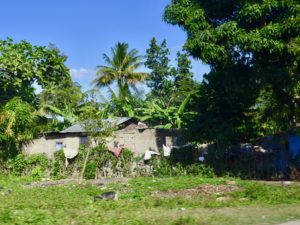
Poverty in Haiti

Haiti is the poorest country in the Western hemisphere, and even during good times is never easy to visit or work in. A government that seems perpetually corrupt, combined with natural disasters (most notably the earthquake of 2010), difficult topography, lack of infrastructure, and massive inflows of foreign aid have left this island nation dependent, poor and frustrated.

The frustration reached a peak last week, when riots erupted in the capital, Port-au-Prince, and the second largest city, Cap Haitien—right where I was. I flew from Boston on Sunday, February 10, after at least 7 months of planning, and 16 years in the making. At last, I was going to start a hemophilia program in the country. Yes, 16 years in the making. That’s a story for another blog.

I landed on Sunday and was home Monday night. Only 24 hours in Haiti. Almost all our plans foiled. But it was not a total loss. I was able to meet two of the 11 boys I know with hemophilia. And that made the whole adventure worthwhile.
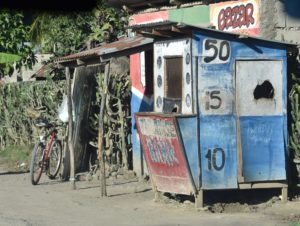
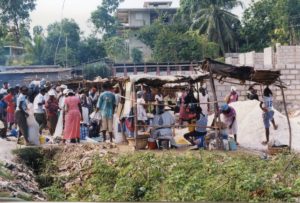
Vendor shack

I met up in Miami on layover with Barbara Campbell, executive director of the Dalton Foundation, which does a lot of great health care work in Haiti. Her group is connected with the Cap Haitien Health Network (CHHN), a nonprofit based in Orlando, which has guided me for the past 11 years in trying to establish hemophilia care. Barbara is competent and energetic, and obviously loves Haiti.

This is the irony of Haiti: as bad as it gets, as frustrating as it can be, there is something compelling about the country and its people, especially to Americans and American missionary groups. Perhaps because it is only a 90-minute flight from our shore: we feel a kinship with this sad piece of earth. Perhaps it’s because we know there must be a solution; I mean, it’s a tiny country—how hard can it be to fix? It’s right in our backyard. Let’s bring in the help, the food, the seeds, the money, the medicine, the manpower—let’s fix this place up! It hasn’t quite worked out. For all we have invested in Haiti, it festers in the heat. And still we want to make it the beautiful country it should be.

Two hours later, Barbara and I landed in Cap Haitien, and were met by our driver, “Charles,” who also happens to be a lawyer and CPA. The day was sunny and surprisingly dry, and I looked forward to an afternoon with two brothers with hemophilia. But Charles told us we were not going to the hotel first, as planned; it would be too dangerous to drive in and out of that area twice. There were roadblocks and bonfires in the streets, and protests. Better to go see the boys now, and make only one trip into the gated Hotel de Roi Christophe. We piled all our luggage (mostly gifts) into the small van and took off. We got lost a few times, but it was a quick 30 minute ride to the boys’ home. The roads were worn and torn, and traffic was light. We got lost a few times but finally pulled up to a quaint, deep turquoise-colored single level house on a packed dirt road.

See photo gallery of trip here.
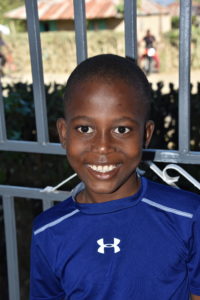
Steven Saintil

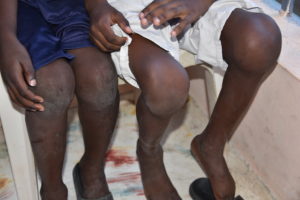
There to greet us is June Levinsohn, an American from Vermont, who has worked in Haiti for 30 years and speaks fluent Creole. Spry and direct, June is one of the most dedicated people I’ve ever met, and her dedication and knowledge gives her the right to be honest and blunt when speaking about Haiti. And it was June who helped put us in touch with the two brothers. June saw a photo of Steven Saintil in the Coastal Haiti Mission newsletter back in early June. No one seemed to know what was wrong with the child with the swollen knees in the photo, but June asked Dr. Ted Kaplan of the CHHN, who then referred the child’s case to me. Looking at his knees, we all suspected hemophilia. In an extraordinary feat—keeping in mind none of us had even met—we had Steven’s blood drawn and flown into Miami, where a pathologist I know picked it up and diagnosed Steven with severe hemophilia A! And Project SHARE began sending factor to him last September, via his local doctor.
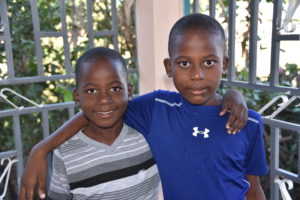
Steven and his brother Louvens, who has hemophilia too

There to greet us is June Levinsohn, an American from Vermont, who has worked in Haiti for 30 years and speaks fluent Creole. Spry and direct, June is one of the most dedicated people I’ve ever met, and her dedication and knowledge gives her the right to be honest and blunt when speaking about Haiti. And it was June who helped put us in touch with the two brothers. June saw a photo of Steven Saintil in the Coastal Haiti Mission newsletter back in early June. No one seemed to know what was wrong with the child with the swollen knees in the photo, but June asked Dr. Ted Kaplan of the CHHN, who then referred the child’s case to me. Looking at his knees, we all suspected hemophilia. In an extraordinary feat—keeping in mind none of us had even met—we had Steven’s blood drawn and flown into Miami, where a pathologist I know picked it up and diagnosed Steven with severe hemophilia A! And Project SHARE began sending factor to him last September, via his local doctor.

And here we were now, with Steven! Although 11, Steven is small, but I am happy to say his knees look a lot better than before. With the factor donations, he was able to return to school, which is just down the road. It’s a Christian school, and Pastor Cody, who looks out for Steven and his half-brother Louvens, was with us that day.
Steven and Louvens knew who I was, and I interviewed them a bit. The father of each boy is gone, disappeared, not wanting to deal with a sick son. The mother is dead; she died from a parasitic infection six years ago. “The doctors pulled a worm out from her,” June shared,  “that was working its way out of her body through her arm. Her infection was too far gone by the time she sought help.” The boys are now orphans technically, and live with their aunt. The aunt has a small son as well. The house was neat, with furniture and a toilet—which surprised June—but it was not functioning. Concrete walls and floor, lots of dust, but lots of vegetation to give it a more cultivated look.
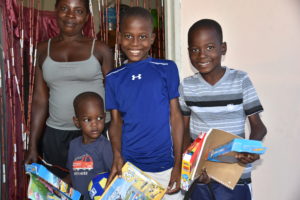
Thanks to uniQure employees for the toys!

The boys look clean, well fed, and happy. And happier still when I opened the duffel bag filled with toys donated from uniQure! I had asked the boys if they had any toys, and they shook their heads. Pastor Cody said, “They find things to play with—a tire, a stick.” Now they had pads of paper, markers, Black Panther coloring book (kudos to whoever donated that! Huge hit), small soccer ball, more coloring books, backpacks, soap, toothbrushes, cold packs, crayons, Matchbox cars (small war waged over who would keep those), and more. Now the boys smiled widely and really warmed up! I had also printed out a photo of Steven using a walker; the photo fascinated the boys. Now Steven was walking better, but damage had been done. His hip now thrusts out to overcompensate, which could lead to problems down the road. We will need a PT in soon to help teach the local PTs how to correct this.
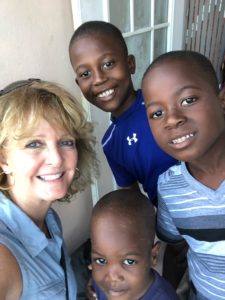
Laurie Kelley with Steven and Louvens

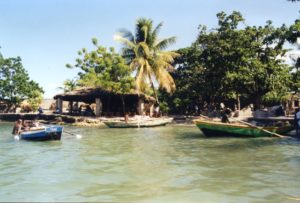
Due to the escalating violence, we had to cut our visit short. With high fives, we said goodbye, and piled back into the van. June was staying with friends, and Barbara and I headed back to the hotel. As we neared the center of Cap Haitien, a scene as horrifying as the riots appeared. Absolute mountains of trash undulating on the beach. Cap Haitien sits on a bay, where fishermen catch their daily wages in handmade dugouts. They were barely visible in the bay due to the heaps of trash. I’m used to seeing trash on the street in developing countries but this range could have its own name and topography. Colorfully dotted with ubiquitous blue and pink plastic bags, the everything in their way.

Turning a corner towards our hotel, we could see the smoldering ashes of where the bonfires had been that day. A UN Peacekeeper tank rumbled by, startling us as we took a right, and police cars patrolled. The crowds were mostly dispersed—it was suppertime—“But they will come back tonight,” Charles warned. “Do not go out.” He rocketed at high speed, crushing through one faltering barricade and dodging others, to reach the hotel gate, which was locked. “I’ve stayed here many times,” said Barbara, “And they never lock the gate…”
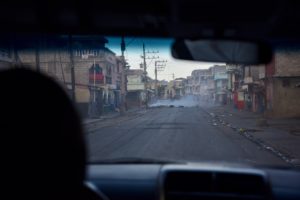
Barricades

At the hotel, Barbara and I checked in; though run down, the hotel was pretty. There were large cracks in the concrete walls and foundation, and desiccated leaves cracked under our feet. We had a delicious dinner and shared our personal stories—hers was fascinating! And then returned to our rooms to check email.

Not long after dinner, Barbara poked her head into my room and said, “We have to leave.” The riots had escalated in Port-au-Prince, and rumor had it that Cap Haitien would explode as well, especially if guns entered the equation. While it might not happen tonight or tomorrow, riots later in the week might mean the airport would shut down. The airport is small, and has almost no security. We had meetings scheduled the next day with the Cap Haitien Health Network to introduce hemophilia, and then a 5 hour road trip to Port-au-Prince, and then the finale—after 16 years of searching, a meeting with what might be our first HTC in Haiti.
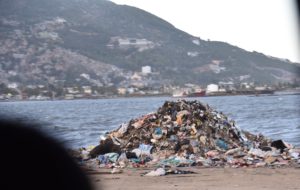
Mountains of trash.

None of it was to be on this trip. We booked the next flight out of Cap Haitien, Monday at 1:35 pm, about 24 hours after landing. As surreal and foolish as it all felt—after all, there was nice Caribbean music coming from the bar in the lounge, and birds hawking overhead in the tree—the situation could turn on a dime. Our colleagues in PAP confirmed it; meeting cancelled, and the US Embassy was issuing advisories and warnings not to travel to Haiti, and for Americans to leave.

The next morning, we packed quickly—I had barely unpacked—and Charles came early to take us to the airport. At 8 am, as we turned down the street, we encountered the first demonstrators. A bonfire raged in the middle of the street as a crowd gathered. About 50 feet away, an angry young man in a red t-shirt spied us and hurled a rock at our windshield. Others got ready to throw and we heard the rocks pelting around us. Charles bravely leaned out and shouted in Creole, waving his arm. The man seemed a bit startled and confused. Luckily, we were hidden a bit in the back seat, our windows darkened. Though I badly wanted to take a photo, I knew this could attract the anger of the crowd too.
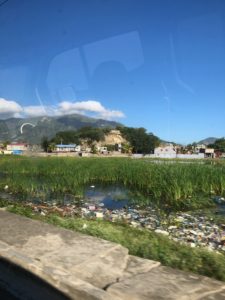
The man waved us through. We sped to the airport and in 15 minutes were there. We were the first to arrive. Eventually the American Airline agents showed up, and had to hand write our boarding passes. In Haiti, anything goes. From there, our lives went on smoothly. We checked luggage, boarded the plane, connected in Miami, and separated to our homes.

For those in Haiti, they were home, which was descending into a dangerous madness.
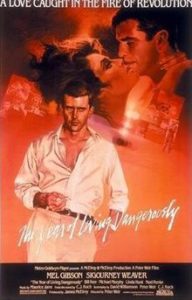
My favorite movie

On the flight home, I watched my favorite movie, The Year of Living Dangerously, starring Mel Gibson, a 1982 movie about a journalist covering the deterioration of Indonesia in 1965 under a corrupt government. There were a lot of parallels with what I was witnessing, including the last scene, where Gibson’s character escapes the madness and poverty, and heads for London. I couldn’t help but feel guilty, knowing what I was leaving behind me.

June shared with us a message from a friend in Haiti last week:  “The food and water crisis is already upon us — not so much [where we are] because we still have rice and are able to buy some beans. So the kids are still getting their one meal a day. But in the surrounding community people are already going whole days or more without food either because the markets are closed or even when the markets have food, they don’t have the money to buy it. The price of food has almost doubled since this began (and, because the value of the Haitian gourde has plummeted this year, the prices were already higher than normal).” And since then, riots have worsened in PAP, and people have been killed.
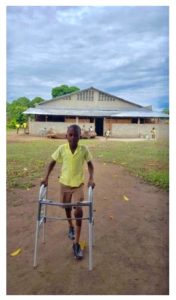
Steven’s photo in September after getting his first dose of factor: he’s walking again!

We will return to Haiti and resume; we’ve come too far and actually have a foothold now with hemophilia care. Pray for Haiti, and its people. They have suffered too much to stop now. We will continue to send factor to the boys we know. I have a registry of 11 boys with hemophilia, and am the only one who knows who they are, and where they are. I had hoped to transfer this knowledge to the local teams and start the first national registry. So I must return. And want to return.

See complete photo gallery of Haiti here.


Haiti: Little by Little

Piti, piti, wazo fe nich li. Little by little the bird builds its nest —Haitian saying.

I’ve either done a very poor job or a very good job trying to get hemophilia care to Haiti. I started in 2001, solo, trying to figure out the puzzle that is Haiti. It dawned on me in 1996, when I attended my first world congress in Ireland, that very few people from Africa or African descent were in attendance. And from that point on, I made sub-Sahara Africa and Haiti (the first free black nation!) a personal mission.

I was able to help start hemophilia societies in Ghana, Tanzania, Zambia, Uganda, and now Rwanda. I was the only one visiting Zimbabwe over a 12-year stretch. I was the first in the global community to visit Kenya, which had a society technically in 2001, but not very active. All of these national organizations, with the exception of Rwanda, which is still forming, are doing well. Kenya is doing great, in particular! I merely was a catalyst and instigator. The families and patients in the countries, and their physicians, deserve all the praise for their dedication.

But Haiti. It sits a mere 90 minutes off our coast. No one from Haiti with hemophilia and no physician from there has attended a world congress. So many have died; one I know from a tooth extraction. The only factor they get is what we have been sending through Project SHARE. We know now about 11 patients, and we have the only Haitian patient registry—not the Haitians. There is no treatment center, no one trained in hemophilia, in short, nothing.

All that is about to change.

Haiti is the poorest country in the western hemisphere, with an estimated population of over 10 million, of which 60% live below the poverty line. It has one of the worst life expectancies in the world (At my age, I’d be considered almost ready to die) It suffered a devastating earthquake in January 2010, which collapsed the country’s health care system. A World Bank report in 2017 noted that the annual per capita public health spending in Haiti is $13, compared with $781 in Cuba and $180 in the Dominican Republic.

Infectious disease is a high risk; in October 2010, the UN peacekeepers improperly disposed if human waste into Haiti’s main river system and caused a massive cholera outbreak. Cholera was new to Haiti, and over 10,000 died from it!

There has never been a national hemophilia program in Haiti. So my aim these many years has been to start the first national hemophilia program in Haiti’s history. What I needed was a hospital willing to be the center, the hub of everything hemophilia. And above all, the center to which we should ship our donated factor. Right now we are shipping to one child in an orphanage over in the west, then to another boy in the capital, Port-au-Prince, then to another boy in the northeast. Crazy! The requests have come in over the years from various healthcare workers who have been to Haiti, and found a child they think has hemophilia. We help get them tested and then send medicine.

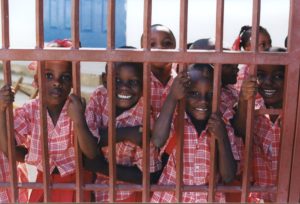
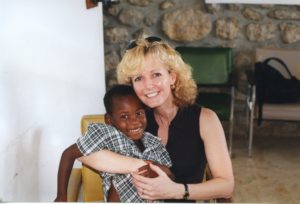
Laurie Kelley in 2002 with school boy

The impetus started many years ago, probably about 2000, when a pastor from Haiti was visiting in the Midwest and asked for factor for two boys he knew. He contacted one of our NHF chapters, I forget which one by now, and they redirected him to me. I was torn because I had factor but just couldn’t give it to a stranger, without a physician’s oversight and approval. So the pastor went back to Haiti empty-handed. About a year later he returned, with the same request. Again I had to turn him down, but asked if I could come to Haiti to check it out, meet the boys and their doctor, to verify it. He put me in touch with the Christianville Mission group, and they invited me on their next mission trip. When I told the wife of the leader of the mission I had to see first if I could get corporate sponsorship for the trip, she immediately replied, “Maybe God wants you to pay for it yourself.” That resonated loudly. I put my own money down and before I knew it, I was going to Haiti.

That was a life-changing trip, and I had been to a few countries by then. Going to Haiti was a bit like going back in time. Unlike almost any other country, Haiti is so isolated. Surrounded by Spanish-speaking and English-speaking countries, Haitians speak Creole, and French. The are hard-working people, and long suffering. The island has been battered by hurricanes and earthquakes, and corrupt politicians.

I met the boys, and their father, who were all impressive. The father was director of a 120-employee mission compound, with 1,200 school children. He spoke English, Spanish, Creole and French! His teen boys had hemophilia, and we provided the factor. We had a great visit and I had hoped he would spearhead our efforts to start a hemophilia program, but in the following years, he emigrated to the US, to give his children a better future. And they are doing great now. I am now friends with one of the boys, now a man, on Facebook!

So I return again… this road to Haiti hemophilia care could be a book. I have four pages of contacts of people through the years who have helped, tried to help and who have left a legacy. I have voluminous notes and stories, and photos. This trip today is the culmination of all their efforts, all of our efforts.

And this time, we will succeed!


The Day the Music Cried

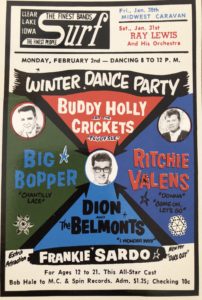
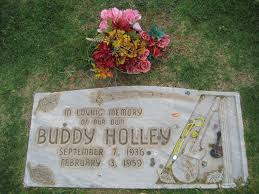
Today is the 60th anniversary of what was dubbed “The Day the Music Died,” by singer Don McClean in the song “American Pie.” The day that singer Buddy Holly, Ritchie Valens and The Big Bopper died in a plane crash in an Iowa cornfield at 1 am on a frigid morning, after performing at the Surf Ballroom. Besides the song immortalizing the young men, the movie “The Buddy Holly Story” commemorates the life of Buddy Holly, who was surely one of the most amazing and talented rising stars in his time. Great movie, with Buddy Holly spectacularly played by actor Gary Busey.

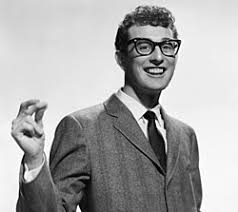
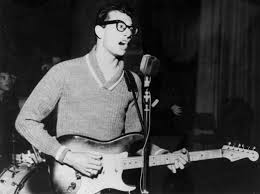
I recently watched the movie, and then read a biography on Buddy. He is undoubtedly one of my favorite musicians in rock. His talent cannot be overstated. When he died at age 22 in the crash, he was already a global sensation. He wrote and performed 50 songs, with the blockbuster “Peggy Sue” often dubbed as one of rock’s great songs. (In 1999, the song made it on the NPR 100, a list of the 100 Most Important American Musical Works of the 20th Century”) Buddy traveled the world, visiting Australia and England, where he was revered. When he performed in England, a 15-year-old Bob Dylan watched him in awe from the audience, as did a young group called the Quarrymen (later The Beatles). They were mesmerized that someone like them—a young man— could make it so big. That he wrote his own songs (singers and performers usually didn’t do that then; Elvis sure didn’t). That he started getting into production of his music. That he couldn’t even read music! His talents were natural and sharp. He created a new genre—rockabilly, combining the country-western style of his home state Texas with leading edge rock and roll.


His band was called the Crickets; different tales speculate on the origin of the name but for sure, if you listen to the song “I’m Gonna Love You Too,” you will hear a cricket chirping at the end of the track. One was in the studio and they couldn’t silence it. And it’s also true that the name the Crickets inspired another band, called the Beatles. Paul McCartney is quoted as saying, “If there hadn’t been a Buddy Holly, there would have been no Beatles.” The British group the Hollies are named for him. Weezer has a song called “Buddy Holly.” The Rolling Stones first US hit was a cover: “Fade Away” by Buddy Holly. And the Quarrymen (Beatles) first ever 45 was “That’ll Be the Day.”

Holly went on to inspire musicians for years and decades after his death. When you think of his brief life, and realize there was an amazingly small window of only 18 months from when he emerged on the music scene till his death, it’s absolutely incredible what he accomplished. And he was mentoring a young and struggling musician named Waylon Jennings, who was performing with them the night of the crash. Waylon gave up his seat to the Big Bopper (J.P. Richardson), who was suffering from the flu. None of the young men wanted to travel in the old school bus that kept breaking down, with no heat, another 10 hours to Minneapolis in the cold. Buddy chartered the plane. Waylon would suffer survivor guilt for years afterwards. The plane crashed within minutes of take off at 1 am. All four people on board were killed instantly.

The movie, often dubbed “The Buddy Hollywood Story,” is not terribly accurate. Paul McCartney, a huge fan, made a documentary about Buddy Holly, after the first movie, to set the record straight. (And he bought the entire catalogue of Buddy Holly songs.) Unlike how he is portrayed in the movie, Buddy wasn’t arrogant, never tried to punch anyone. As a Texan Baptist he was polite, and incredibly creative.


What does all this have to do with hemophilia? Nothing, except our community has so many young talented musicians, waiting for their chance. Buddy’s story is inspiring—I highly recommend reading Buddy Holly: A Biography by Ellis Amburn. And listen to his music: it’s magical, uplifting, clever, innovative. Buddy made it cool to wear glasses (John Lennon, very visually challenged, took to wearing his specs on stage after seeing Buddy). Buddy made it cool to look like a geek and be a star. He never doubted himself a second, and I hope our young stars never do either.

Dust off your guitar and send your music to Blood Vibrations (https://bloodvibrations.bandcamp.com/), a group from our community, which will promote your music on their website and in their album. They’re waiting for you.

And Rave On!

Hemophilia Notes

Music is figuring prominently in the movies lately: A Star is Born, the third remake with Lady GaGa and Bradley Cooper, is a musically and emotionally rich film about how success changes people. Bohemian Rhapsody… need I say anything at all? A biopic about the irreplaceable and eternal Freddie Mercury, who has frequently been rated as having one of the greatest voices in rock history and who created one of the often-rated top 10 rock songs of all time. He’s my second favorite singer (Jim Morrison of the Doors being first).

Music has long been an art form to express emotions and thoughts that are not easily given to words. Music is so tied to emotions that many of us can hear a song, and remember a place or event that happened when we first heard it. It taps a different part of our brain than reading; it can express feelings that we cannot put into words, unless a verse accompanied by music.

For example, “Love of My Life” was Freddie Mercury’s favorite song, according to one biography, because despite his fame, he often felt alone and mistrusted many people around him.

The bleeding disorder community also has its own music, designed to give a voice to feelings that are not easily expressed. Sometimes music with lyrics, sometimes just music. Blood Vibrations is an on-going, grassroots collaboration with various talented artists in the community, to provide a forum for creativity, expression and learning. With songs like “I Am Alone,” “Everybody Counts,” “Patience is a Virtue,” “Alone,” you can see there are some deep feelings to explore and share. Pain and suffering are often doorways to these deep feelings and dark thoughts, and music is one way to relieve and process these. The artists may even be people you know, like Jenny Massey, Kevin Finkle and Jozef Zwier, though many are using pseudonyms, like Cell Division and Bleeder. Listen to their songs, and understand bleeding disorders more. I write books on hemophilia, but there is great value in hearing music about it.

I love music; I am picking up my piano again, after a 5-year hiatus, inspired by these artists. I play classical piano but am also attending a Metallica concert tomorrow in Raleigh, North Carolina. Music has many voices, all valid! If you haven’t listened to Metallica, I would recommend them. When I heard “For Whom the Bell Tolls,” I could have sworn I heard Bach fugues in it. Sure enough, reading their bio, I learned that the late bassist Cliff Burton studied Bach. He died at age 24 in 1986 in a bus accident, but the band survived and remains a top draw in heavy metal.

Read about music too. I love bios about musicians, to learn what inspired them, how they crafted their songs, what paths their lives took to get them where they are.

My favorite rock bios: Life, by Keith Richards (Rolling Stones)— the best. Intelligently written, brilliant and funny. Weaves music theory into explaining why the Stones were so successful with their music, and who influenced them. Born to Run by Bruce Springsteen—it was a long road with many hardships and lessons to become someone who I think is the hardest working person in rock. The Paths We Choose by Sully Erna (Godsmack)—expelled from preschool for fighting, Sully only hit fame when he trusted his gut instinct and struck out on his own, and oddly, didn’t think he could sing. Mercury and Me by Jim Hutton—the movie took a lot of liberties with Freddie’s life; this one tries to balance out factor and fiction from the viewpoint of Freddie’s partner at the end of his life. No One Here Gets Out Alive: the Biography of Jim Morrison by Danny

Sugarman and Jerry Hopkins—This one doesn’t have a happy ending, but it documents the rise and fall of the 1960s great rock band, their influence and the sad outcome of one of the greatest front men, and poets, in rock.

For fun? Slash by Slash and Dancing with Myself by Billy Idol. Hey, why not?

Explore music. Which is your favorite genre? Band? Singer? Writer? Why? What one song moves you like no other? Music unites like almost no other art form. I will see that for myself when I disappear into a crowd of 50,000 tomorrow, all singing with, cheering at and feeling the power that is Metallica.


Explore Blood Vibrations too. You too can submit a song; it doesn’t even have to be about a bleeding disorder. Send to bloodvibrations@yahoo.com.

I’ll be waiting to hear it!

  Long Live Rock!


The Last Hemophilia Princess

The English royals have always interested Americans, even though we gave them the boot back in 1776. “The Crown” is a popular Netflix show, and the princesses, from Diana to Kate and now Meghan, seem to fascinate us. The hemophilia community is even more fascinated, as the most famous carrier in the world must be Queen Victoria, who up until recently was the longest reigning monarch in English history. Only one of her nine children, Leopold, had hemophilia, and she passed along the gene to two daughters, who later had children with the hemophilia gene, including the famous Alexei Romanov, son of Nicholas II, the last tsar of Russia. The Romanovs and Alexei’s story makes for astounding history, and indeed, may have changed the course of world history (order Alexis: The Prince Who Had Hemophilia to learn more).

But who was the last princess? Our researcher nonpareil, Richard Atwood, shares a review about a book on Beatrice, based on the book by Matthew Dennison, The Last Princess: The Devoted Life of Queen Victoria’s Youngest Daughter (2007). 

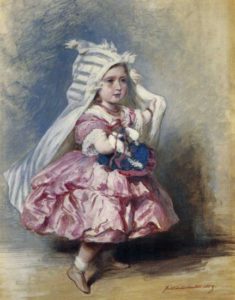
Over 18 years of marriage, Queen Victoria had four sons and four daughters, aged four to 17. She delivered her last child, Beatrice Mary Victoria Feodore, on April 14, 1857. For the second time, Dr. John Snow administered chloroform as an anesthesia for the birth. Beatrice was a bright and precocious child. While she began lacking playmates as her older siblings were marrying or leaving the household, Beatrice had her dogs, cats, birds, and ponies as company. Her father, the Prince Consort, died in 1861 when she was only four. Her mother would grieve as a widow for the next 40 years. By default, Beatrice became her mother’s comforter, companion, and caretaker.

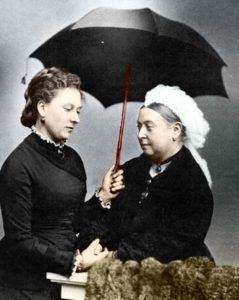
Beatrice attended her first grown-up meal in 1863, and regularly sat at the Queen’s dinners beginning at 15. Her older brother, Leopold, was a part-time invalid by 13, often confined to bed, due to his hemophilia. Beatrice herself developed acute rheumatism and lameness by her early twenties. She visited European spas to be treated with massage and healing water, plus, later in life, took trips to the warmer Mediterranean. She also had neuritis in her hand, right arm, knee, and foot. Her sister, Princess Alice, who was in poor health due to rheumatism, neuralgia, tiredness, and headache, died of diphtheria in 1878 when only 35. John Brown, the Queen’s companion, died in 1883 after 19 years of service. Leopold died in 1884.

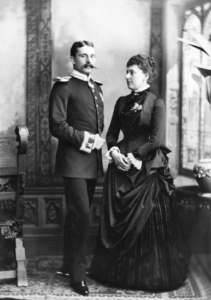
Queen Victoria ended any potential romance between Beatrice and Louis of Battenberg, but allowed the marriage of Beatrice to Henry of Battenberg, called Liko, in 1885, provided that Henry give up his independence, military career, German nationality, plus live with Beatrice and the Queen. Beatrice replaced her sisters, and Liko replaced Leopold, to serve Queen Victoria. Beatrice was the shyest of the 9 siblings, and also the most devoted of the daughters. She had a retiring and unassertive manner, was uncomplaining, and had a habit of avoiding eye contact. Beatrice was radiantly happy with Liko, and, following a miscarriage in 1885, had three sons and a daughter: Alexander, Victoria Eugenie (“Ena”), Leopold, and Maurice. Leopold (1889-1922) had hemophilia. The birth of Ena, a hemophilia carrier, was assisted by forceps and occurred at Balmoral, the first royal birth in Scotland in 300 years.

In 1896, Liko volunteered for the Ashanti Expedition in West Africa and died of malaria. Queen Victoria died in 1901. Beatrice, as literary executor, would edit and rewrite the 111 volumes of Queen Victoria’s journal over the next 30 years. Ena, thought not fluent in Spanish, married Alfonso XIII of Spain in 1906, and converted to Catholicism. Her firstborn and male heir, Alfonso, had hemophilia. Three of Beatrice’ssons served in the military during the Great War. Maurice died in 1914 at Ypres. Leopold died in 1922 following an emergency operation complicated by his hemophilia. Beatrice suffered from rheumatism and bronchitis, unable to walk and breathe. She died an invalid and a widow of 48 years in 1944, the last princess, at 87 years.

Hemophilia is no longer in the English royal family, which is why you don’t hear about it anymore as the “royal disease.” The heirs of Beatrice and Alice who carried or had hemophilia are all gone.   


HemaBlog Archives
Categories