Laurie Kelley

Pfizer’s Give Forward Program offers you a way to give back to your community

The hemophilia community has a
big heart and is always there to help others. I have my own international
nonprofit to help those with hemophilia in developing countries. And there are
programs right here in the United States that can help hemophilia related charities. 

Below is one such program. Please read and click through to learn more!

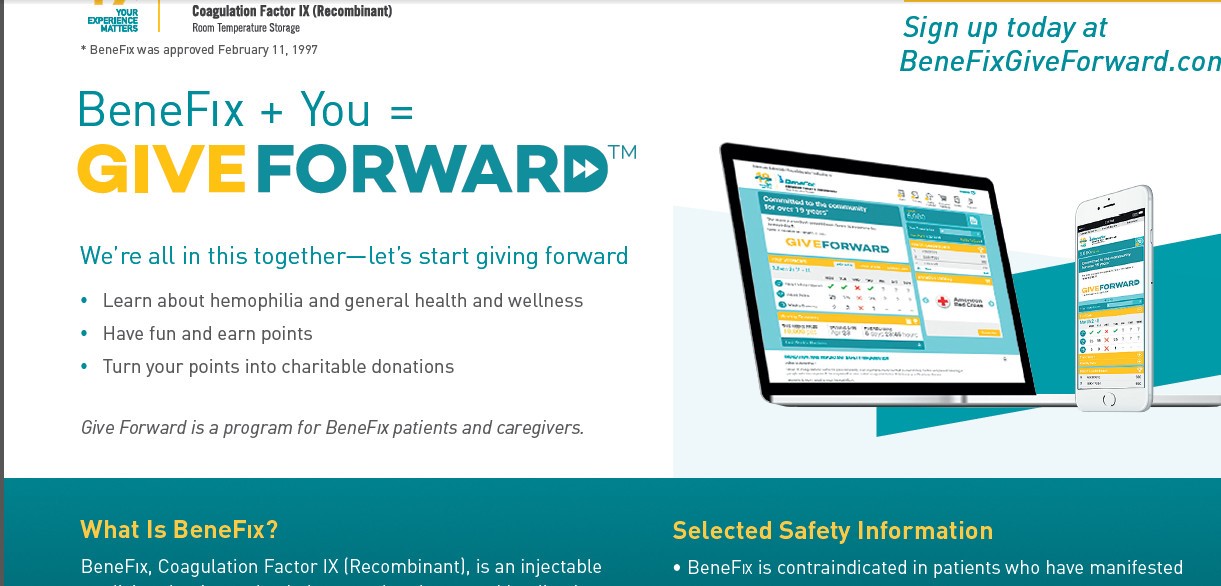
The free BeneFix Give
Forward Program provides you with the opportunity to earn points and then turn
your points into charitable donations for organizations that mean the most to
you. How are these points earned? By engaging with Pfizer Hemophilia’s content,
programs, and services on the Give Forward website.

 
The
BeneFix Give Forward Program is
mobile friendly, so you can take it on the go without downloading an app.
Sign
up today at BeneFixGiveForward.com to see how you
can start earning points!
What Is
BeneF
IX?
BeneFIX, Coagulation Factor IX
(Recombinant), is an injectable medicine that is used to help control and
prevent bleeding in people with hemophilia B. Hemophilia B is also called
congenital factor IX deficiency or Christmas disease.
BeneFIX is NOT used to treat
hemophilia A.
Important
Safety Information
·       BeneFIX is contraindicated in patients who have manifested
life-threatening, immediate hypersensitivity reactions, including anaphylaxis,
to the product or its components, including hamster protein.
·       Call your health care provider right
away if your bleeding is not controlled after using BeneFIX.
·       Allergic reactions may occur with
BeneFIX. Call your health care provider or
get emergency treatment right away if you have any of the following symptoms:
wheezing, difficulty breathing, chest tightness, your lips and gums turning
blue, fast heartbeat, facial swelling, faintness, rash or hives.
·       Your body can make antibodies, called
“inhibitors,” which may stop BeneFIX
from working properly.
·       If you have risk factors for
developing blood clots, such as a venous catheter through which BeneFIX is given by continuous infusion,
BeneFIX may increase the risk of abnormal
blood clots. The safety and efficacy of BeneFIX administration by continuous infusion have not been
established.
·       Some common side effects of BeneFIX are nausea, injection site reaction,
injection site pain, headache, dizziness and rash.
Click here for full
Prescribing Information.
You are encouraged to report negative side effects of
prescription drugs to the FDA. Visit
 www.fda.gov/medwatch, or call 1-800-FDA-1088.

PP-BEN-USA-0188-01

As I Get Older

This is a lovely essay submitted by one of our PEN readers, a reflection on what an older gentleman in our community has learned… and wishes to share with younger people.
By Richard Hiteshew
I am
75 years old and have severe hemophilia B. I infuse twice weekly, 5,000 IU. When
I was growing up I thought that I would not be able to walk in my later years
due to the hundreds of leg injuries I sustained as a child. I still walk but
have had other difficulties. Frankly, I was not prepared for advanced age. In
the interest of helping others avoid some of the pit falls, I would like to
give some advice.
First
and foremost, you must own yourself. You have a disorder. I remember my mother
telling me when I was six or seven years old, “Richard, you were dealt a
bad hand, make the most of it.” Hemophilia has been referred to as the “royal disease.” It was in the German, Spanish, English and Russian royal families in the 1800-1900s. I believe it is called the royal disease because
it is a royal pain! Hemophilia is a chronic disorder that can, in 15 minutes of
sustaining an injury, become critical. You must personally own it and learn how
to work with it.
Proverbs 16:18 says pride goes before a
fall. Get handicapped tags for your car. Buy a four-prong cane. Get rid of your
pride. You may be in a wheelchair, crutches, braces, or have a terrible limp.
So what? Hold your head high and remember that there are people who have it a
lot worse than you. Purchase a fold up chair that has side arms. The arms will
help you get out of the chair. Keep the foldable chair in your car. Purchase a
lift chair to help you get up for home use. They are very expensive, but you
can buy them for a deep discount on Craigslist.
I have
all of my original joints except for my right shoulder. Several years ago I had
to undergo total reverse shoulder replacement. The reason for the replacement
was a loss of cartilage in my shoulders. That loss was caused primarily by
lifting myself from a sitting position using my arms instead of my legs. I also
had to lift myself from my many sports cars. The sports cars are fun but sit
low to the ground, and we unknowingly injure ourselves getting in and out. So
lose the sports cars and get a minivan. It is my experience that the best
minivans for impaired people are the midsized like the Ford Escape, Cadillac
SRX, and BMW X3. A good test is that you want the seat to be butt level. You
also want the vehicle to have wide doors to allow easy entry and exit.
Prevent
falls. When walking, even for a short distance, never try to carry something in
both hands. You need a free hand for balance or to steady yourself. Put handrails
on all steps, even if it is only two or three. Additionally, put grab bars
anywhere you may need them. I have nine grab bars in my bathroom. I also have
them at every step down in my home, both inside and outdoors. Make your home
handicapped accessible.
When
walking, never, ever step out of someone’s way. Side stepping is dangerous.
Stand still and let the other person walk around you. Never walk backwards for
any reason. You cannot see what is behind you. Learn to fall down. It’s called
tuck and roll. If you feel yourself falling, tuck your arms close to your body
with one hand over the other and turn your body so you will land on your
shoulder. Your shoulder will take a hit better than your hip. Don’t try to
catch yourself. That is how elderly people break their arms or worse yet, their
wrists. If you are walking on grassy surfaces, either use your cane or hold
onto someone’s arm. Divots in grass can drop you in a flash.

Finally,
be your own advocate. Don’t listen to other people who say “It’s going to be ok.”
If it’s not ok, there is only one person in the world that will suffer the
consequences: you. If you are not comfortable with anything, assert yourself
and say no. If you are mistaken you can always have a do over. Learn as much as
you can about your disorder so that you know more than anyone… maybe even your
doctors!

How to Handle a Bleeding Disorder During the School Year


The start of a new school year is a stressful and exciting time for both kids and parents. If you’re the parent or caregiver of a child with a bleeding disorder, you have a lot more to consider than just which school supplies to buy. There are precautions you can take before and during the year to ensure things go as smoothly and safely as possible. 
Talking to Your Child 
The best way to prepare for the new school year is to get together with your child, their doctor, and the school staff to agree on a plan. Start by having a one-on-one conversation with your child. Make sure they understand their condition and encourage them to speak up if they need help or are experiencing a bleed while in school. They should know how important it is to take care of their bleeds right away. 
Talking to a Physician 
Next, meet with your child’s hemophilia treatment center (HTC) doctor or nurse to come up with a treatment plan. Talk about your child’s participation in sports and other physical activities. You should sit down with the HTC doctor or nurse before any meetings you have with the school regarding bleeding disorders, because it is good to have an overall understanding of things yourself. 

Talking to the School Staff 
It is important to plan a meeting with the school staff before the school year is in full swing. If you haven’t done this yet, try to organize a meeting as soon as you can; don’t wait for back-to-school night when teachers will be busy meeting with many parents in one evening. 
Contact the school nurse, counselor, or principal to organize the meeting. You should talk about safety precautions, the storage and possible use of treatment in school, and the importance of not singling out or embarrassing your child. People who should be at the meeting include: 
  • You and your child 
  • Primary teacher(s) 
  • Gym teacher 
  • School nurse 
  • An administrator (eg, principal, vice principal) 
  • A previous teacher who has experience with your child’s condition (if available) 
What to Do During the Year 
During the school year, your child needs to be comfortable speaking up if or when bleeds occur, and teachers should be able to recognize bleed symptoms as well. Provide them with a checklist of basic symptoms, as well as an emergency contact list of whom to call if a bleed happens. The same goes for gym class and after school activities—if your child can participate in these activities, the staff should be on the lookout for bleeds or other issues. 
If the bleeding disorder causes absences or missed schoolwork, you, your child, and their teacher(s) should work together to figure out the best way to get caught up. Your child should know that it is okay if their condition prevents them from completing some work on time, but that bleeds are not an excuse to put off responsibilities. 
Working as a Team 
Perhaps the most important thing is to keep in mind that everyone involved is part of a team. You all have the same end goal: to help your child have a productive and enjoyable school year. The school staff may not have much experience with bleeding disorders, which is why it’s important that you all work together throughout the year to ensure your goals are reached. 
For printouts on bleed symptoms, emergency contact information, and other useful resources for the school and your child, visit the NovoSecure™ downloads page
This is a sponsored message from Novo Nordisk. 

Learn About the History of Two Prolonged Half-life Therapies

We’ve
been focusing on changing therapies in the hemophilia community the past two
years, including products that give us more options and choices. Read below to
learn about how Biogen scientists developed two products that are being used to
help improve hemophilia care.
Please see below for the Indications
and Important Safety Information
In
2000, Rob Peters and Jenny Dumont, currently top scientists at Biogen, wanted
to make a difference in hemophilia care. They saw that hemophilia therapy
hadn’t changed since the 1970s and there was an unmet need for a
new class of treatment.
Rob,
Jenny, and their team knew it wouldn’t be easy. They were fully aware that it
often takes years, even decades, to get a therapy from that spark of
inspiration through research, clinical trials, and FDA approval to the
community who so eagerly wanted an alternative therapy.
Rob
has a PhD in biochemistry from Harvard and is a VP, Hematology Research, at
Biogen. Jenny has her PhD in cell biology from the University of Cincinnati
College of Medicine and is the Medical/Scientific Director, Global Medical, at
Biogen. Both certainly had the education and training to tackle such a daunting
challenge. More importantly, Rob and Jenny had an unwavering passion to develop
new therapies.
Their
passion helped them stick with it and in 2014, after a decade and a half of
hard work and determination, Biogen launched prolonged half-life ELOCTATE® [Antihemophilic
Factor (Recombinant), Fc Fusion Protein] and ALPROLIX®
 [Coagulation
Factor IX (Recombinant), Fc Fusion Protein].
Prolonged
half-life ELOCTATE and ALPROLIX have been helping people with hemophilia for
the past two years. In that time, doctors have written thousands of
prescriptions.
Rob
and Jenny recently returned from the National Hemophilia Foundation and World
Federation of Hemophilia meetings, where they had the opportunity to talk with
people who have been taking ELOCTATE and ALPROLIX. They got to see, firsthand,
that their perseverance and passion was well worth the effort.
“Bringing
ELOCTATE and ALPROLIX from inception to the people who need them was a lot like
raising children,” Jenny says. Jenny is a mother of 2 and grandmother of 3. “You
give them so much of your energy and attention for so many years, then let them
go into the world and hope they make an impact.”
Rob, father of eight-and-a-half-year-old twins, agrees, adding: “I was raising my twins the
same time we were developing ELOCTATE/ALPROLIX. That really helped me
appreciate the potential of what more time between infusions could mean in the
lives of families with kids with hemophilia.”
Learn
about the science behind ELOCTATE  and ALPROLIX .
ELOCTATE Indications
ELOCTATE
is an injectable medicine that is used to help control and prevent bleeding in
people with hemophilia A (congenital Factor VIII deficiency). Your healthcare
provider may give you ELOCTATE when you have surgery.
ELOCTATE Selected Important Safety
Information
Do
not use ELOCTATE if you have had an allergic reaction to it in the past.
ALPROLIX Indications
ALPROLIX
is an injectable medicine that is used to help control and prevent bleeding in
people with hemophilia B. Hemophilia B is also called congenital Factor IX
deficiency.
Your
healthcare provider may give you ALPROLIX when you have surgery.
ALPROLIX Selected Important Safety
Information
Do
not use ALPROLIX if you are allergic to ALPROLIX or any of the other
ingredients in ALPROLIX.
This blog was sponsored by Biogen for
educational purposes.
HEM-US-1198
08/16
©2016
Biogen. All rights reserved.

Baxalta, now part of Shire

Powered by their commitment to you.

There’s been a lot
of change in our community this year, but perhaps none so impactful as the
change in Baxalta, now a part of Shire. Please read below to learn more about
these changes, and click through to learn how Shire will keep on serving you!
Shire, is built on
strength and experience, and is powered by an enduring commitment to you. Each
company brings world-class products, as well as, a foundation for sustained
category leadership in rare diseases.
Combining 60 years
with 30 years of dedicated history to bleeding and rare disorders communities,
the new company has even more resources to offer. What that means for patients
is that Shire is maintaining its solid commitment to you while still offering
innovative products. Introducing new treatments for bleeding disorders, and
making a meaningful difference in the lives of patients and families continues
to be Shire’s main focus.
Shire’s combined
product offerings have expanded the range of therapeutic areas. Shire and
Baxalta are combining 30 years with 60 years of dedicated history to the rare
disease and hematology community. Together they are commitment to the
hematology community.
This is a paid announcement by Baxalta, now part of Shire.
August 2016

USBS/MG1/16-0527a
HemaBlog Archives
Categories