Laurie Kelley

Know Your Factor Choices

It’s truly a new era in bleeding disorders with new products, new therapies and new indications. Octapharma’s wilate just got approval for indication in adults and adolescents with hemophilia A; previously it was indicated only for VWD. With this news, I realized that we should remind everyone to know what product they use, where it comes from, and why they are using it.

Who chose your product? Was it your hematologist? Did you have any input? You should, and this means bearing the responsibility to read about products, as questions about them and be part of the decision making process.

Back in 1990, when Raising a Child with Hemophilia was first published, we were the first ones to describe parents and patients as consumers, and to treat products like any other commercial product you would buy. We provided the question to ask your doctor, and we explained the different manufacturing processes, and the difference between safety and purity. And we urged parents not to be passive in the treatment process but to help make medical decisions.

It’s more important now than ever. We have a dazzling choice of products, and novel therapies like Hemlibra. Maybe there’s no reason for you to switch products, but you might want to get up to speed on what’s available. Please note: all US FDA-approved products are considered safe and efficacious.

We’ve been writing about products and product choice for decades. I hope you read up on them and be prepared! To help you, we created a chart of products that you can download. Take it to the HTC with you and discuss with your hematologist about choice. You can download it right from our home page or go here.

We also have a chart for VWD products too!

We did our part. Now do yours; know your product, manufacturer, and why you use it. Keep learning… more therapy choices are coming!

NHF’s 71st Bleeding Disorder Conference

I just returned from Anaheim, California, where the 71st bleeding disorder conference was held. From Thursday till Saturday night, this unique community gathered to share stories, learn from one another, hear experts speak on a variety of subjects. I’ve been attending since 1992, and I think I’ve only missed one, in a year when I gave birth to my third child. This year, however, was quite special. It marks the end of an era: NHF CEO Val Bias is stepping down as leader.

I always feel funny using the term CEO with Val, because he is more than just that title to this community. He has been a friend, camp counselor, mentor and activist. He always has a ready smile, and a demeanor that makes you feel he has all the time in the world to chat with you.

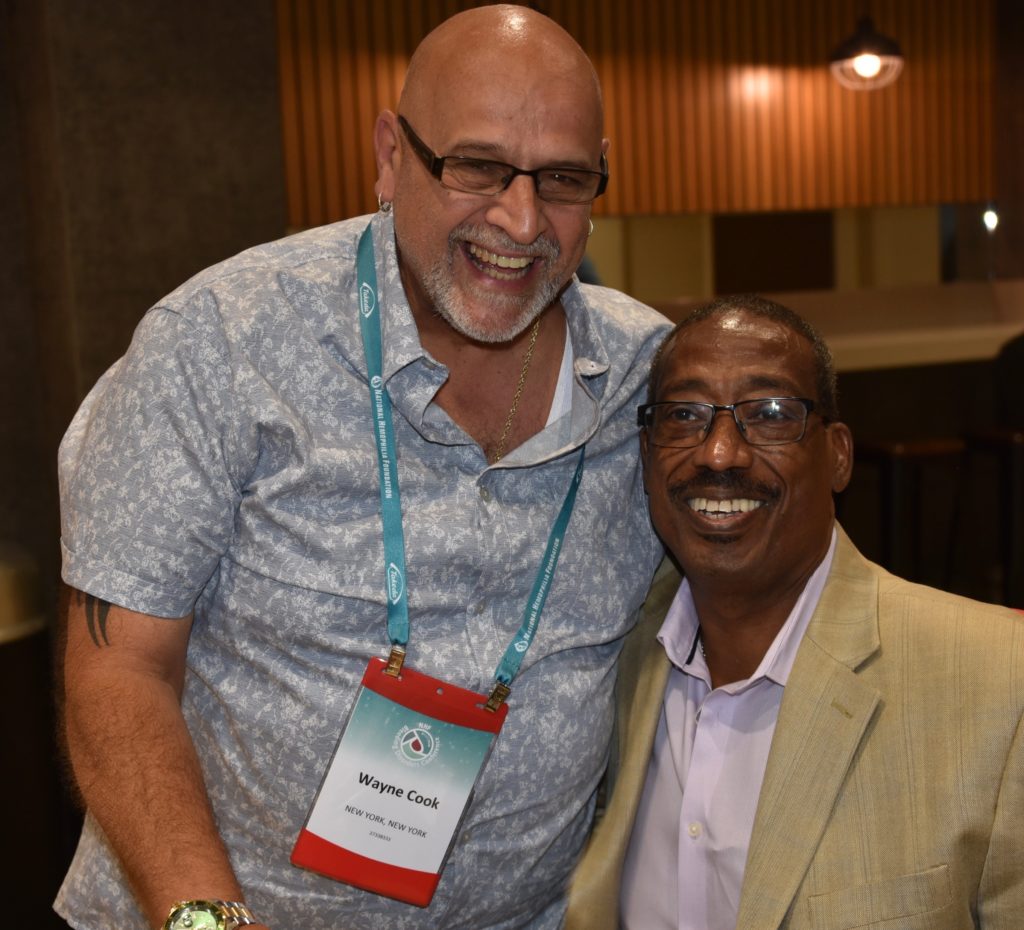
Wayne Cook congratulates Val Bias

I didn’t always perceive him that way. I first saw Val when in 1992 I attended my first NHF annual meeting in Atlanta. This was at the height of tensions between the consumer advocacy groups and pharmaceutical companies, during the HIV crisis. One group of activists even dressed as grim reapers, poured red paint on themselves to represent spilled blood, and walked among the booths at the exhibit hall, banging a drum. It was chilling, and everyone was on edge. Many pharma reps left, especially after they had received death threats. The exhibit hall became deserted.

Kim Phelan, executive director of the Coalition for Hemophilia B congratulates Val Bias

I attended one session, a town hall, where people could speak up and bring their complaints and air their views. At the head of the room was a podium and table, at which sat representatives from our community: Bill Sparrow, Rachel Warner, and a few others whose names I can’t recall. In the front row, an angry Michael Rosenberg, who had hemophilia and HIV, and who headed an advocacy group that was seeking justice for the HIV infection of factor. I didn’t know all the issues at that time but watched as Michael eventually was on his feet, yelling at the speakers on the podium, and the room erupted! The community was angry, hurt… poisoned. Children and adults had died. The tension was incredible.

Out of this pandemonium came a voice from the podium asking everyone to calm down and to sit down. It commanded the room, and everyone listened. People stopped shouting; people sat down. I was amazed and wondered, who is this guy, who can bring order to chaos and calm people with a commanding voice and apparently, reputation?

That was my very first impression of Val, a leader in a time of crisis. He has played many roles in our community, including helping to bring the Ricky Ray bill into law, which provided compensation to those with hemophilia who were infected with HIV and hepatitis C. He’s been a fighter on the front line for blood safety, and more recently, a fighter to keep access to all therapies in the face of insurance barriers.

Laurie Kelley with Val Bias

The opening night of NHF last week was a tribute to Val. A beautiful video, with testimonies from former NHF president Mark Skinner and current NHF COO Dawn Rotellini, shared his contributions for the past 11 years as CEO and his contributions to the community overall. It’s a life well lived. It always struck me that while Val too was infected with HIV and hepatitis C (his first wife died shortly after being infected by him), Val never seemed to harbor bitterness. He only sought justice.

We will miss his leadership. But we hope that he will stay visible in the community, to share his warm smile, hearty laugh, wisdom and friendship. He leaves a legacy, and very hard shoes to fill.

An IXperience that’s anything but ordinary

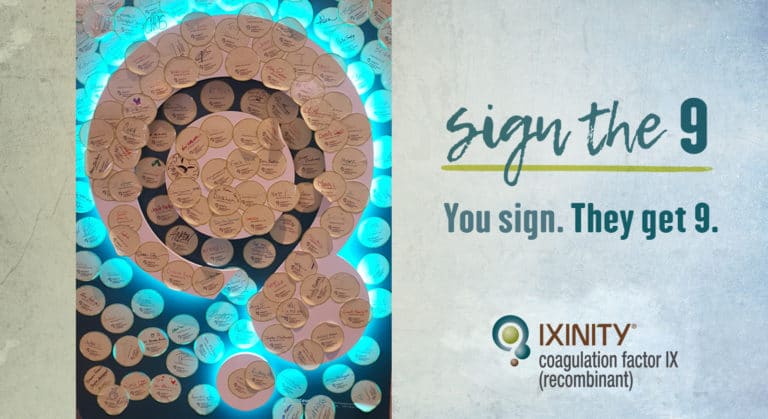
The hemophilia community has always taken care of its own, and I’m happy to help support the efforts of Aptevo, makers of the factor IX treatment IXINITY® [coagulation factor IX (recombinant)] to continue this tradition as part of the IXINITY IXperience. Read on to learn more about the FACTOR IT FORWARDTM program and how you can help give back to the factor IX community by signing the 9!


This is a paid public announcement from Aptevo and does not constitute an endorsement of products or services. When you click on the links in this blog entry, you will be directed to the IXINITY website. LA Kelley Communications always advises you to be a savvy consumer when contacting any company; do not reveal identifying information against your will.

FACTOR IT FORWARD

As part of the IXINITY experience, every IXINITY patient has the opportunity to give back to the US factor IX community just by choosing to infuse. When your healthcare professional enrolls in the program, for every 10 IU of IXINITY distributed, 1 IU is donated to factor IX families in need across the United States. That means a nine who infuses 4000 IU twice a week helps FACTOR IT FORWARD donate more than 40,000 units a year to US factor IX families in need!

Learn more at IXINITY.com

Sign the 9

Sign the 9 is another way you can help give back to your community. When you Sign the 9, every signature received will make 9 IU available for donation to people in need across the United States as part of the FACTOR IT FORWARD program for IXINITY.

Already this year, almost 1,000 people have signed the 9! It’s another step we’re all taking to make sure we leave no nine behind. Connect with your local rep, or if you plan to attend the National Hemophilia Foundation Bleeding Disorders Conference in Anaheim, CA on October 3-5, be sure to stop by and Sign the 9!

LIVE LIFE YOUR WAY WITH IXINITY 

Predictable bleed control for your unpredictable life
  • In a clinical trial, 71% of bleeding episodes were resolved with 1 infusion and 13% were resolved with 2 infusions.1 Individual response may vary
Higher recovery means more factor on board after infusion
  • IXINITY has an average incremental recovery of 98%1
Flexibility to plan peak factor levels for your everyday, active lifestyle
  • 24-hour half-life for peak factor IX levels when you need them1
See why switching to IXINITY may be right for you

INDICATIONS AND IMPORTANT SAFETY INFORMATION

What is IXINITY®?

IXINITY [coagulation factor IX (recombinant)] is a medicine used to replace clotting factor (factor IX) that is missing in adults and children at least 12 years of age with hemophilia B. Hemophilia B is also called congenital factor IX deficiency or Christmas disease. Hemophilia B is an inherited bleeding disorder that prevents clotting. Your healthcare provider may give you IXINITY to control and prevent bleeding episodes or when you have surgery.

IXINITY is not indicated for induction of immune tolerance in patients with hemophilia B.

IMPORTANT SAFETY INFORMATION FOR IXINITY

  • You should not use IXINITY if you are allergic to hamsters or any ingredients in IXINITY.
  • You should tell your healthcare provider if you have or have had medical problems, take any medicines, including prescription and non-prescription medicines, such as over-the-counter medicines, supplements, or herbal remedies, have any allergies, including allergies to hamsters, are nursing, are pregnant or planning to become pregnant, or have been told that you have inhibitors to factor IX.
  • You can experience an allergic reaction to IXINITY. Contact your healthcare provider or get emergency treatment right away if you develop a rash or hives, itching, tightness of the throat, chest pain, or tightness, difficulty breathing, lightheadedness, dizziness, nausea, or fainting.
  • Your body may form inhibitors to IXINITY. An inhibitor is part of the body’s defense system. If you develop inhibitors, it may prevent IXINITY from working properly. Consult with your healthcare provider to make sure you are carefully monitored with blood tests for development of inhibitors to IXINITY.
  • If you have risk factors for developing blood clots, the use of IXINITY may increase the risk of abnormal blood clots.
  • Call your healthcare provider right away about any side effects that bother you or do not go away, or if your bleeding does not stop after taking IXINITY.
  • The most common side effect that was reported with IXINITY during clinical trials was headache.
  • These are not all the side effects possible with IXINITY. You can ask your healthcare provider for information that is written for healthcare professionals.
 For more information about IXINITY, please see full Prescribing Information, including Important Patient Information.
 
You are encouraged to report side effects of prescription drugs to the Food and Drug Administration. Visit www.fda.gov/medwatch, or call 1-800-FDA-1088.

Reference: 1. IXINITY [coagulation factor IX (recombinant)] prescribing information. Seattle, WA: Aptevo BioTherapeutics LLC; December 2018.

Aptevo BioTherapeutics LLC, Seattle, WA 98121

IXINITY® [coagulation factor IX (recombinant)] and any and all Aptevo BioTherapeutics LLC brand, product, service and feature names, logos, and slogans are trademarks or registered trademarks of Aptevo BioTherapeutics LLC in the United States and/or other countries.

©2019 Aptevo BioTherapeutics LLC.               All rights reserved.          CM-FIX-0327

Dosage Denied! Where Does Insurance’s Power End?

Samantha* lives in Montana, our fourth-largest state but with one of the lowest populations, at 1.05 million. This means that families with hemophilia have an extra burden of traveling long distances to a hemophilia treatment center (HTC). Samantha’s three sons with severe hemophilia, ages 18, 13, and 11, were used to the 11-hour drive to Denver’s renowned HTC and a 7-hour drive to the closest hemophilia hematologist.

            What they were not used to was a sudden denial by their insurance company of their hematologist-approved factor dosage.

            On January 1, 2016, Samantha switched to a new insurance company, Assurance*, which was registered with the state exchange, or Marketplace. Six months later, Assurance made a curious request. The company asked Samantha to provide the weights of each of her three sons. This seemed odd, because Samantha always provided weights when she ordered factor, but she complied. Then her hematologist and specialty pharmacy received the same request from Assurance. The hematologist sent the weights, along with a three-month prescription. But Samantha was baffled.

            The reason for the company’s request soon became clear. On July 11, 2016, Assurance sent a letter to Samantha’s specialty pharmacy and hematologist explaining that the boys were using factor outside the recommendations of the product insert (PI). The PI is the set of instructions and medical information provided by the manufacturer inside each package of factor. The insurance company claimed that by using more factor per dose than was recommended, the family was acting outside of FDA regulations.

            Shortly after, Assurance sent Samantha a letter declaring it would only authorize the average dose according to the PI, contradicting the prescription of the boys’ hematologist, and cutting the hematologist-ordered doses by 65%.

            This letter shocked Samantha. “I reached out to Assurance via email to ask what was going on,” she recalls. “The company replied, said the hematologist had been notified, and I needed to contact the hematologist and have her reissue a script at a lower dosage. The insurance company kept me out of loop as much as possible.”

            But Samantha was smart: she made notes on every phone call and documented everything.

            Then Assurance sent a one-page letter about the dosage change to the hematologist and specialty pharmacy. Although Samantha requested a copy, she didn’t receive one; her specialty pharmacy finally forwarded her a copy.

            The letter stated that Assurance had an external review board investigate the case, but deceptively, the insurance company requested only a review of the PI’s average dosing, neglecting to send the bleed history of each boy and the recommendations of the hematologist! The letter did not verify who this review board was, or what outside consulting company was used and whether it had included hematologists knowledgeable about hemophilia.

            Samantha knew a fight was coming. Luckily, she was prepared. Her hematologist had recommended using an amount higher than the dose shown on the PI. Each boy’s dose was well documented. “We have 150 pages of documentation showing why each of our sons is on doses higher than the PI,” says Samantha. “Their half-lives, their recovery studies were all done consistently. So the scientific and medical facts were there.”

            The changes recommended by Assurance were shocking: Samantha’s youngest son had been prescribed 130 IU/kg of recombinant factor IX, three times a week. Assurance changed his dose to 80 IU/kg twice a week, a decrease of 67% per month. Another son was prescribed 150 IU/kg, three times a week. Assurance decreased this by 64.5%, down to 80 IU/kg, twice a week.

            Samantha notes, “My boys are very athletic and extremely toned; there’s no obesity. They are big boys. My youngest now weighs 184 lbs and is almost six feet tall. They needed the dosage prescribed by their hematologist.”

            Meanwhile, Samantha’s world became more stressful. “Raising three boys, fighting this battle, it was overwhelming!” Within one week of the lower-dosage change, all three boys had bleeds, flu-like symptoms, aching joints, and headaches. “My oldest son told me everything aches inside him. My middle son took a shower late one night. Afterward, it looked like a blood bath. He had horrific bloody noses. He was ghostly white. Finally we started taking [our sons] to the ER, even for nosebleeds, which we normally treat at home. We weren’t going to the ER for products (the ER doesn’t stock them), but for documentation—proof of their bleeds for the insurance company!” The ER doctor told Samantha that her sons needed factor now. “We told the doctor we couldn’t get the medicine in the correct dosage. Then he wanted to get involved in the fight!”

            Samantha’s youngest son had his first-ever joint bleed in his knee, which bled for a month. He was on crutches for six weeks and needed physical rehabilitation. “We started keeping the boys inside, like in a bubble, so they wouldn’t risk getting hurt. Yet, the boys had spontaneous bleeds.”

            Assurance tried many tactics. The company didn’t return Samantha’s phone calls. It denied and even delayed preauthorization from the hematologist, denied bleed doses, and once, incredibly, even refused to send factor.

            Despite the barrage of phone calls to Assurance from the specialty pharmacy, hematologist, and Samantha, the request for the prescribed dosage was denied. Together, Samantha and her healthcare team filed a grievance with the state against Assurance, following the online procedure. “Assurance became belligerent, to be honest,” Samantha remembers. “It was horrible. We said this change in dosage was life-threatening, and they said it wasn’t their problem. Our hematologist had never heard of any insurance company changing a physician’s script. She would have screaming phone calls with them. But they just would not budge. It was all about the money. They said, if we weren’t happy, we could go elsewhere. They wanted to get rid of us.”

            After filing the grievance, Samantha contacted her state insurance commissioner’s office. She filed an online appeal. It was tricky, because applications are limited to a certain number of characters. But Samantha was clever: she filed an appeal for each child separately, giving her more space to describe what was happening. Samantha also contacted Michelle Rice, vice president, public policy and stakeholder relations of National Hemophilia Foundation, for advice about including key words and points.

            A second external review was requested by the commissioner. When Samantha received the results of this review, she couldn’t believe it. “It was nuts! It agreed with the dosage change by Assurance, and this time we knew who the company was that conducted the review. What info did they base this on? What info was given to the external review company? What do they know about my boys? I started crying. My kids could die.”

            Samantha phoned the commissioner’s office, but the commissioner wasn’t there. In desperation, she called Donnie Ackers of Hemophilia Federation of America (HFA), who coached her on using the right words: “Call the commissioner’s office right away and get a manager. Don’t lose this!” With Donnie’s urging, Samantha called back: “I got ahold of Brenda*…she was literally a godsend. She said this was not acceptable. She took over our case. If not for her, we would still be fighting this. She said what they are doing is feeding you half-truth and lies.” Brenda asked for only one lawyer from Assurance to be her contact, and spent hours on the phone with the boys’ hematologist.

            By now it was August 2016, and Samantha and her boys had gone a month and a half with limited factor. “Brenda emailed me, and said she was going to force Assurance to send the prescribed amount of factor. She challenged them on the external review board’s finding. She called their bluff: Assurance wrote a letter saying it was not their fault; it was the external review board’s fault. Assurance had the audacity to claim the review board put their own numbers in the review, which coincidently matched the lower preauthorization!”

            To keep medical records up to date, Samantha recalls, “We eventually had a new pharmacokinetic [PK] test on all three boys, a 7-hour drive for us to our hematologist. At that time, my youngest had a knee bleed, and had to endure having all these labs drawn. I’ll never forget the drive to the hematologist; they all hurt so much that they slept a long way to overcome the pain.”

            The stress took its toll. Samantha says, “It was a tough time for all five of us. On top of this, we are working full-time jobs; our oldest had to quit his summer job for a while. We were so busy making phone calls, taking notes, caring for bleeds, and worrying about the long-term joint damage on the boys that we never stopped to breathe until Christmas!”

            The state insurance commissioner’s office made Assurance conduct a third review, with the hematologist’s prescription this time. In her incredible efforts to prepare, Brenda compiled records from birth to present for each child, including all scientific evidence (lab results, PK testing), a list of 20 items that an external review board needed, the PI, the original script, the changed script, and documented bleeds.

            “This third external review came not only in our favor, but even more in our favor,” says Samantha. “The board said these boys are not getting enough factor, and they changed the dosage to every 48 hours! And Assurance can never, ever change this, because it’s from the insurance commissioner’s office and follows the procedures outlined in the Americans with Disabilities Act.

            Samantha never dreamed that a manufacturer’s PI would be used as a tool in an insurance company’s attempt to lower costs by lowering dosage. When an insurance company comes between a hematologist’s prescription and a patient’s need, this is playing with life and death. Samantha’s story shows the value of documenting everything—every call, every email, every letter. She was smart to work with her healthcare team, and to never quit. When all seemed lost, Samantha called HFA, and from there, the commissioner’s office…one more time. And that was the straw that broke the back of Assurance’s ludicrous claim.

            Assurance hid behind the PI to start the battle. But the hemophilia community takes any challenge to children’s health head-on. To win.

 *Names have been changed due to pending legal action.

From: Publication: PEN’s Insurance Pulse 09.18

Origins: Save One Life

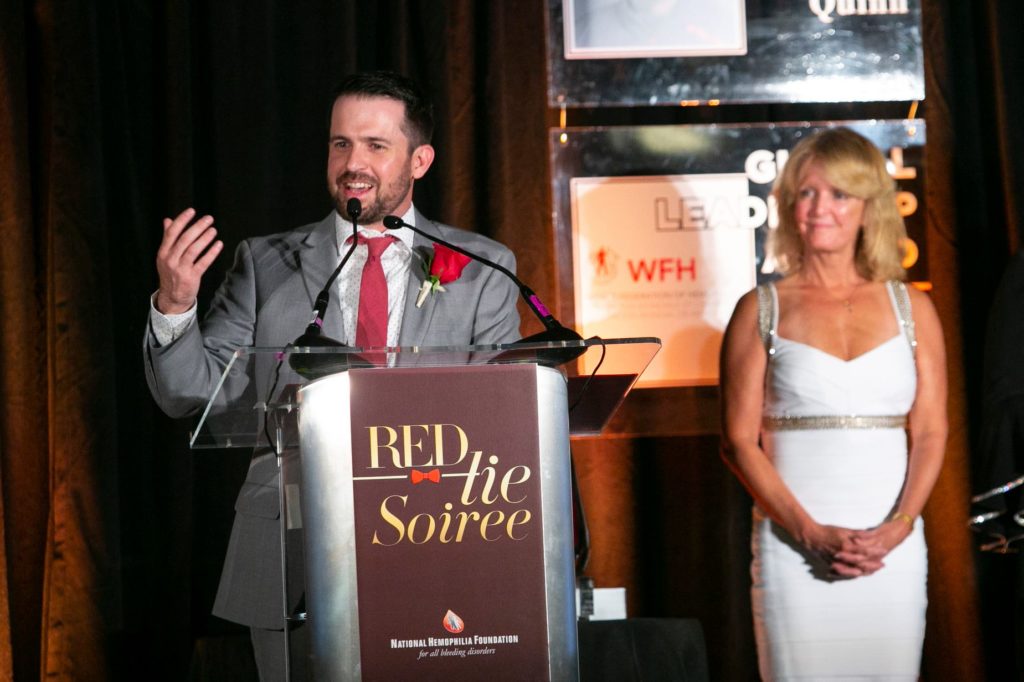
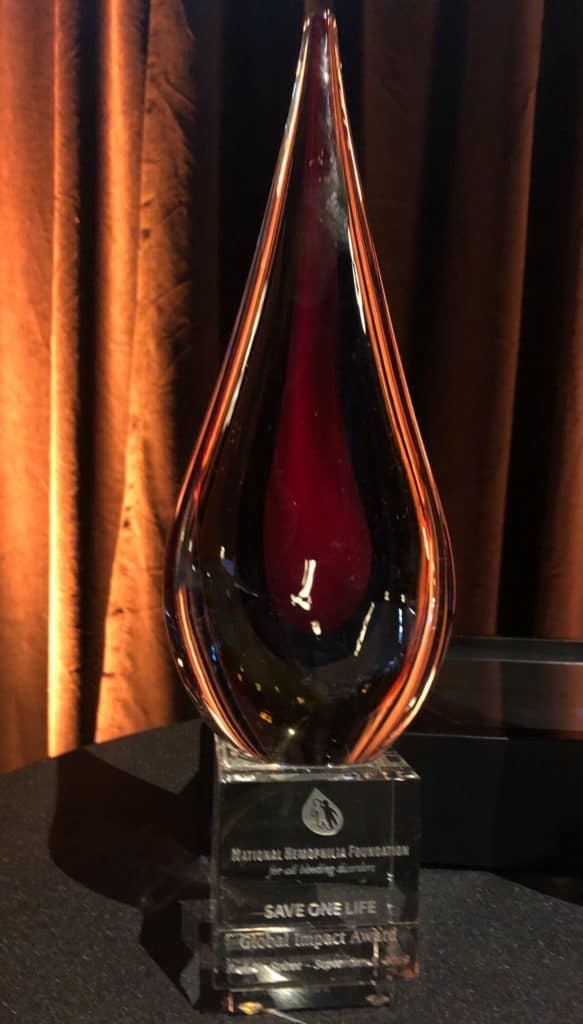
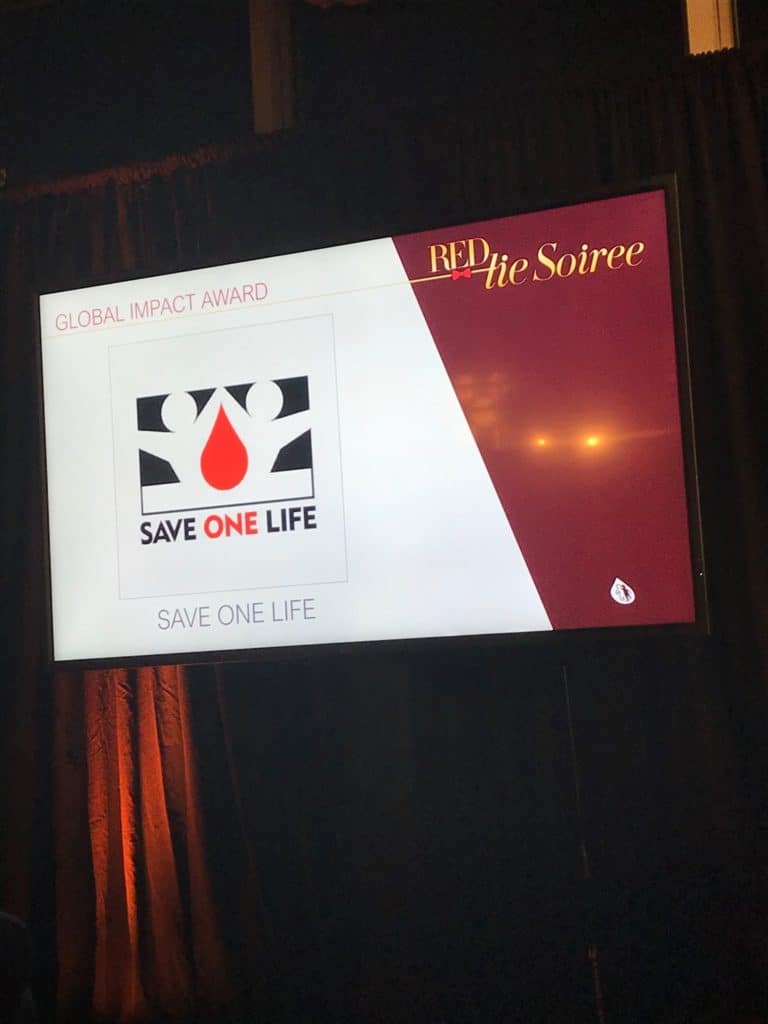
The air was crisp with the coming of Fall when we visited New York City this past Thursday night to attend NHF’s Annual Soirée, a fundraiser that honors various members and organizations in the bleeding disorder community. I have attended once before, a few years ago. It’s a lovely night and chance to get caught up with colleagues and friends, while being dressed to the nines. This night, the nonprofit organization I founded, Save One Life, was to be honored. We were receiving the “Global Impact Award.”

Chris Bombardier giving acceptance speech

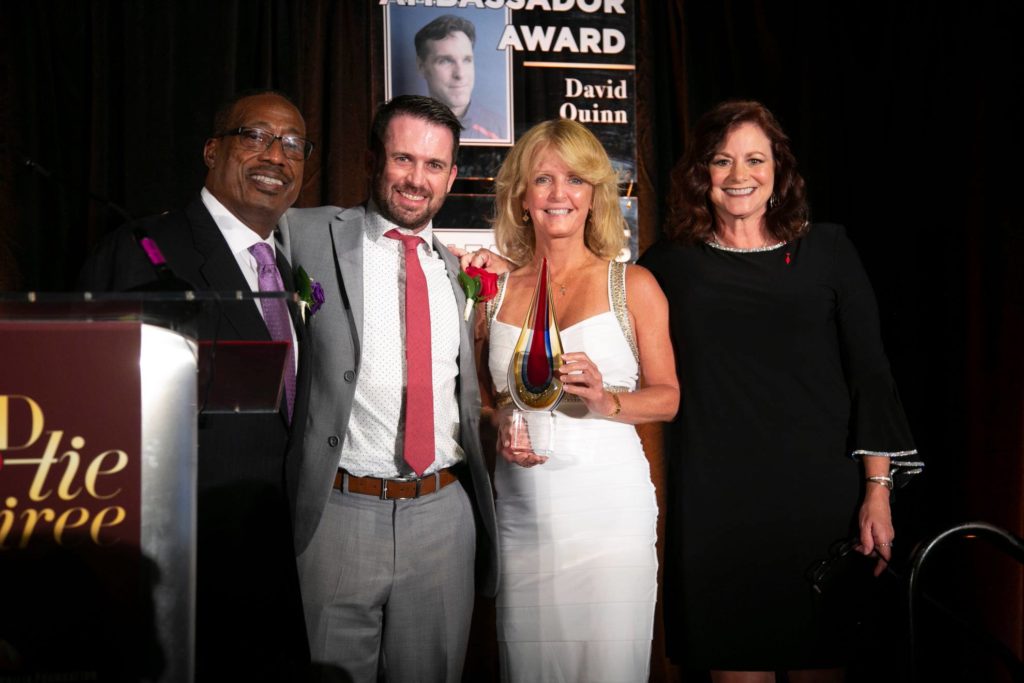
Along with Save One Life, Alex Borstein, television actress and community member, David Quinn, head coach for the NY Rangers and the World Federation of Hemophilia were also being honored for the Inspiration Award, Ambassador Award, and Global Leadership Award, respectively. Congratulations to all who were honored!

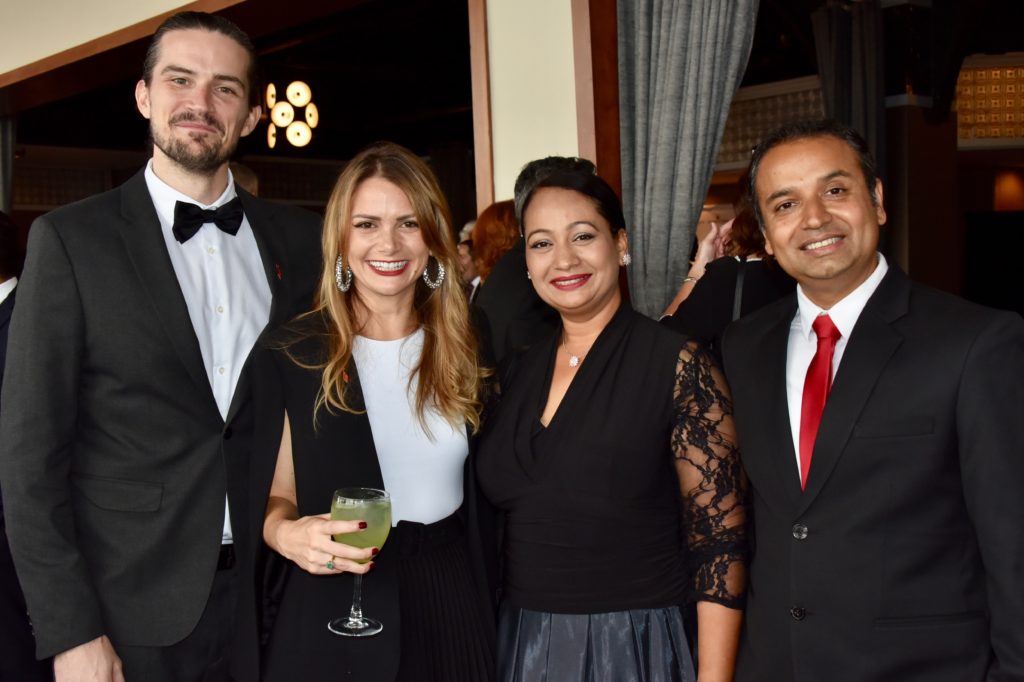
Chris Bombardier, Save One Life’s executive director (and famous mountaineer with hemophilia) and I took the stage to accept the award, while several of our board members looked on. With us were: board member Ujjwal Bhattarai, chair, who helped us found Save One Life, and his wife Sunita, who have a child with hemophilia; new board member Natalie Lynch, and husband Patrick (actor and film director, president of Believe Ltd., who has hemophilia), and board member Kayla Klein, mother of a child with hemophilia who works at Sigilon.

Val Bias, CEO NHF, Chris Bombardier and Laurie Kelley of Save One Life,
Dawn Rotellini, COO NHF

While looking at them from the stage and into the bright lights of the future, I recalled our very humble roots. I spoke to the audience about how Ujjwal and I have worked for 18 years to make Save One Life truly have impact among the world’s poor. It has been a long, difficult and challenging road, but with the greatest of rewards: to help those without access to factor have access; to help those who live on the edge have security; to let those with an uncertain future know they have an organization to count on. After 18 years we have now seen so many of our children in school, graduating, have jobs and even have families of their own.

We had to give credit to Chris, and his daring Seven Summits Quest, which helped raise awareness of Save One Life to the global community. And more than that, the documentary “Bombardier Blood,” directed by Patrick Lynch of Believe Ltd and now produced by Alex Borstein, has catapulted us into the spotlight. We never sought recognition or fame for the work we consider a personal and compelling mission—for me, based on my faith—but the movie has done more for us than just about anything we have done ourselves. We could not thank Chris or Patrick enough for their efforts. Their sacrifices and dedication have been huge. And kudos and gratitude to Octapharma, which funded the last two mega-climbs, and for funding the entire movie.

But absent that evening was a key person, perhaps without whom known of this would have come to pass.

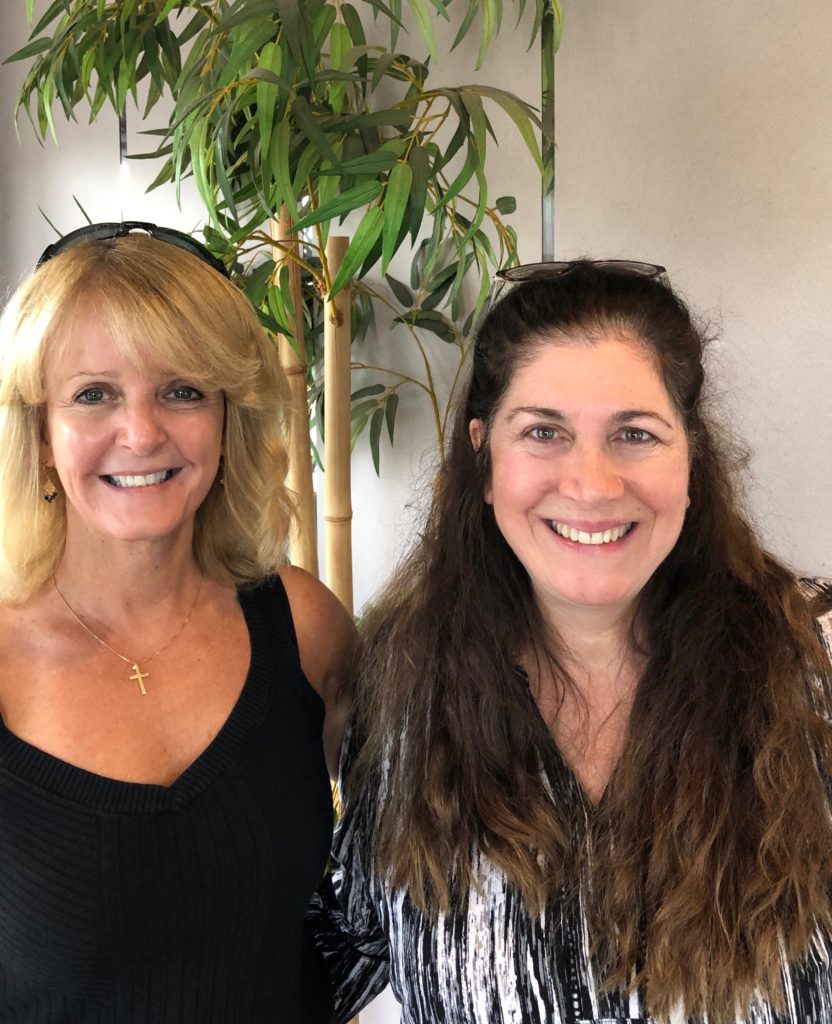
Laurie Kelley with Lisa O’Connor, who created the idea
of Save One Life in 1999

Twenty years ago, a mom from Cold Springs Harbor, New York, not far from where the event took place, sent me a letter. She has a son with hemophilia, only a few years younger than mine, and read my books and newsletter. In 1999, we used to write letters to one another! Hers came on one sheet of yellow lined paper, and on it, she wondered if there was a way to help children with bleeding disorders in developing countries, like Save the Children. I happened to have sponsored two children with Save the Children, one in Lebanon and one in Mali. Not long after she sent her letter, I made my first trip to Pakistan, a country I have grown to love. There, on the Arabian Sea, in a humble, two room dwelling in a very poor area, I sat on a bed with a baby in my lap, listening to a father with a fretful expression speak about his two young sons with hemophilia. He was very poor, only earning about $20 US a month. He wished for an extra $20 a month, to send his oldest boy, Mohammad Ali, to school. With this education, his son could get a good job, once he learned English. I thought this would be an easy fix. And if we could do this for this Pakistani child, why not do it for others? Americans are among the most generous people on earth, and I knew if we appealed to them to help children with hemophilia who were poor and without factor, we could help change lives.

It was Lisa’s letter that kept drawing me back. Could we create a program like Save the Children?  The answer was yes. Yes. Anything is possible!

Now, 18 years later, here we are. Over 2,000 children sponsored. Over $3 million in direct aid. Over 270 college scholarships. Over 80 microenterprise grants. Over 30 camp grants. 13 developing countries. And more to come… .

(See www.saveonelife.net for a short video of Save One Life’s accomplishments so far)

Save One Life board members Ujjwal Bhattarai and Natalie Lynch, with spouses Sunita and Patrick

As it happened, I was going to Huntington, New York after the event to catch a Doors tribute band show at the Paramount Theater. Something rang a bell… I checked my database and saw that Lisa lived right near Huntington. A few texts later and we agreed to meet!

This morning Lisa walked into the Sweet Hollow Diner, and we sat together for breakfast, while I shared all the profound and life-changing programs and stories that have happened over the past 18 years.  She was amazed; with her son grown and gone, she had kind of lost touch with the bleeding disorder community.

I believe in honoring those who make a difference. Save One Life was not my idea; it was Lisa’s. Lisa cast a small stone into a pond, and the ripple effect continues after 18 years, and hopefully will continue for decades to come. Her idea was a catalyst, and so many have benefited from it. Let’s honor Lisa, as well as those Thursday night. It was her vision that gave birth to Save One Life.

Visit https://lakelley.smugmug.com/Events/Galas/NHF-2019-Soiree-Honoring-Save-One-Life/ to see photos of the event!

We need to give ourselves permission to act out our dreams and visions, not look for more sensations, more phenomena, but live our strongest dreams— even if it takes a lifetime. Vijali Hamilton

HemaBlog Archives
Categories