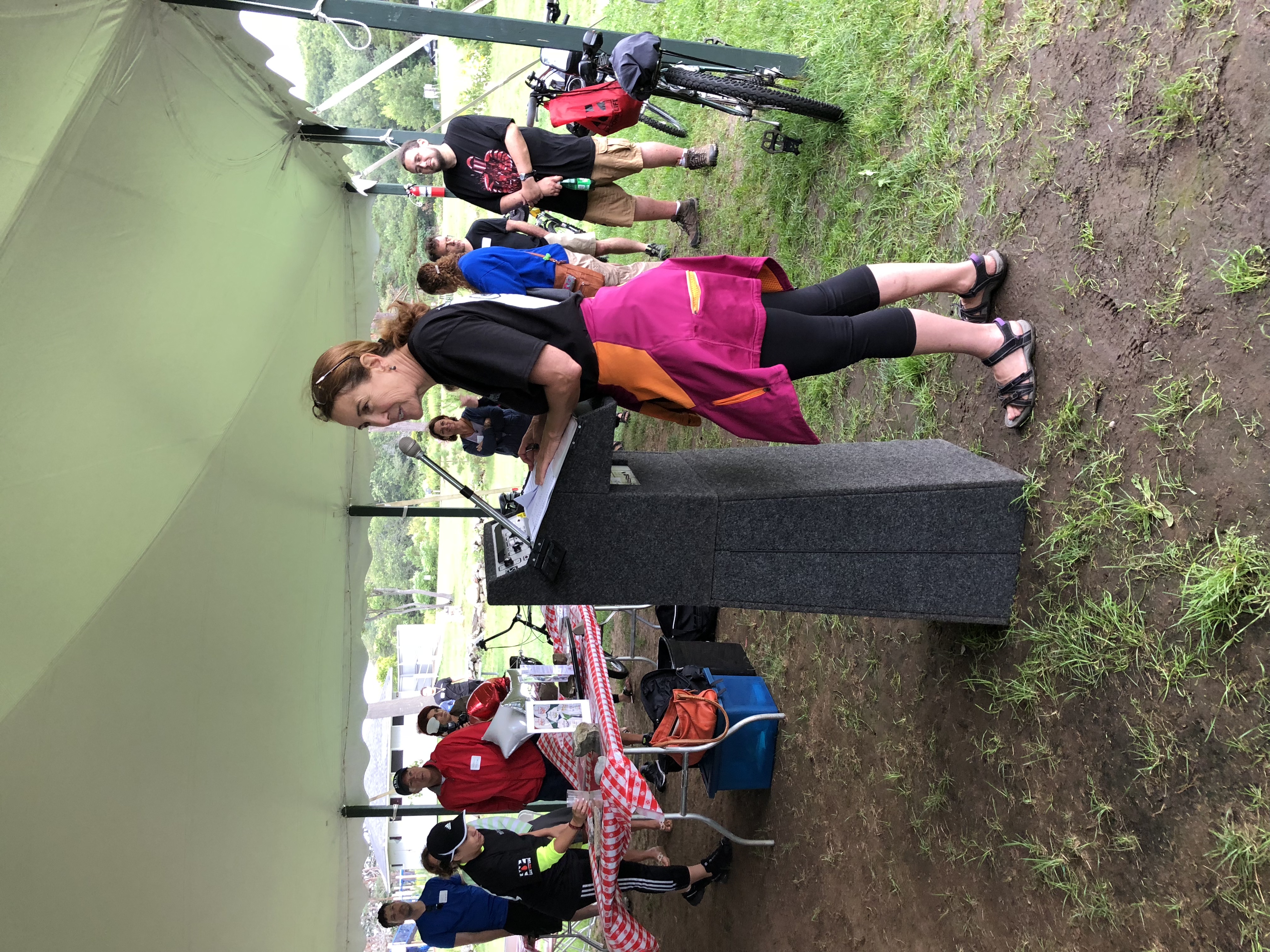
Laurie Kelley

He Planted Kindness: Kyle Callahan

 A tree is known by its fruit; a man by his deeds. A good deed is never lost; he who sows courtesy reaps friendship, and he who plants kindness gathers love.  —St. Basil

I’m in Nashville, waiting to board my flight home, leaving behind many hemophilia community members who came to pay tribute to a fallen giant, Kyle Callahan. Kyle, a 52-year-old with hemophilia, passed away suddenly on August 26. For a man who had survived so much in his life, and engaged in outrageous adventures and high-speed fun, it was stunning news.

Nashville baked in 90° weather when I arrived yesterday afternoon; I hurried over to Union Station, a magnificent building and scene of Kyle and Diane’s wedding 24 years earlier. It was healing to see so many people in our community that I’ve known for decades and admire: Craig Mears and wife Kelly, John Jarratt, Dianne (Martz) Griffith (Kyle’s mother), Louise Hardaway, who helped Dianne set up her original business in 1980 (and is mother-in-law of Pat “Big Dog” Torrey), and more. Our community runs deep in memories, connections and affection.

Diane and Kyle Callahan

Inside the big room where we gathered was a head table filled with memorabilia: A Harley Davidson sign, a signed football, a photo of his beloved Doberman, a collage of the many adventures he and his wife Diane shared.

Kyle was born in South Dakota, but always revealed a bit of a southern accent, after living in Nashville most of his life. I met Kyle in 1992, after first meeting Dianne, his mother, who had just started Hemophilia Health Services, a specialty pharmacy that prided itself on the “human factor.” More than just a slogan, HHS was the booth at NHF meetings that had soft colors, music, chairs and warm representatives. Dianne created a new way of providing factor to customers, with a high-touch, personable approach. My first meeting with Kyle is imbedded in my mind: a tall, good-looking 26-year-old who looked years younger, with strawberry-blond hair, freckles and a dazzling smile. About 7 years later, Dianne retired and Kyle was nominated by the board to become president. I wondered how this “young man” could possibly take on this responsibility?

He assumed responsibility and would later rocket HHS to become the largest hemophilia specialty pharmacy in America. From revenues of $30 million to over $1 billion.
I watched Kyle grow, and he became a friend, a colleague, mentor and supporter of my work. I needed an article reviewed for accuracy; Kyle agreed to do it. I needed a book reviewed—Kyle again agreed! I needed to interview a captain of industry about changing insurance—Kyle again. I wanted to set up a factor donation program to stop the waste of unwanted factor—Kyle invited me to Nashville to learn how their operations ran. That tour became the basis of how we constructed Project SHARE, so we were in compliance. And that came in handy when one morning at work I looked up, and an FDA agent named Jason was staring down at me, badge in hand, because he heard we were shipping “drugs.” We sailed through our first inspection with flying colors.

HHS collected factor that patients returned, and donated them to us. Kyle helped fund the program, which continues today, and which has given over $130 million worth of factor to developing countries.

When I wanted to start a child sponsorship program, Save One Life, Kyle again agreed to help support us. And he and Diane sponsor 17 children with hemophilia in developing countries.
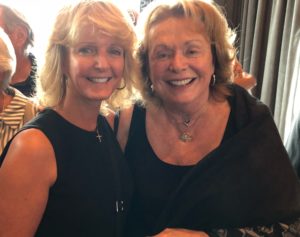
Laurie Kelley with Kyle’s mother, Dianne Griffith, founder of Hemophilia Health Services

But above and beyond all this, the most important, most impressive things about Kyle were not so quantifiable. That charming man with the dazzling smile I met in 1992 never once wavered in civility, humility, and kindness. And he endured much; at one NHF meeting, I barely recognized him. I’m afraid I stared when I saw him; he was so gaunt from his illness. But still, that smile. That charm. He always was gentle. He always was available. He seemed to carry no baggage; he was present, in the moment, focused on whoever he was with. He laughed easily and smiled perpetually. He was the real deal. That’s called integrity.

Kyle and I connected on helping others less fortunate, but also on the lighter side of things. We were both adventurers, and I loved reading about his adventures and he liked knowing mine. I joke that he flew planes; I jump out of them. He drove race cars; I tried cooking. We both loved traveling to foreign places, the more exotic the better! I always tried to send him a birthday card each June, except for last year when I confessed I was climbing a volcano in the Congo; he gave me a pass!

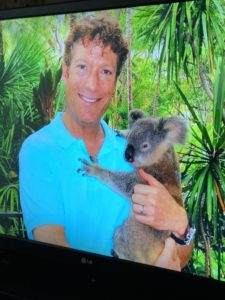
After he retired for a time, before he started a new venture, he and Diane took a few years to travel the world. I have Christmas cards of them in Egypt, sitting on camels; holding a koala bear in Australia.

When I learned he and Diane were going to Antarctica, I was so excited for them and envious—it’s a place I have always wanted to visit. I’m a voracious reader about polar exploration. Following an NHF meeting, waiting at the airport, I shared my knowledge of polar exploration and especially the Shackleton story. Kyle assured me they were going to South Georgia island to see his grave. It’s a hunk of rock that contained an old whaling station. Would it be possible to send me a postcard from there (in case I never get there myself)?

Not long after I received a postcard of Ernest Shackleton’s gravesite from Kyle and Diane. That is kindness itself.

I  have kept that postcard on my bookcase, next to all my travel and adventure books, to remind me to go there someday. Someday…

The postcard seems to be a calling card now, to get with it, and live life like Kyle. Our days are numbered, and no one knows when we will depart. Kyle flew planes, scuba dived, drove race cars, was a pilot, drove a Harley, commanded a beautiful yacht. And through all of it, he never lost his gentle grace, his smile, his zen-like composure, his kindness, his humility. He never said a bad word about anyone. And no one, not even his competitors, ever said a bad word about him—an amazing feat in the specialty pharmacy business. Everyone who spoke yesterday said the same thing: he was perhaps the kindest person you could ever meet.

Kyle’s message to me seems to be: 1) Live each day to the fullest, 2) chase your dreams; they can come true! and 3) be kind. Always. To everyone.

Good-bye Kyle, and thank you for leaving the world a better place. More adventures await you, and we will try to catch up with you one day!

Diane Callahan has asked that donations in Kyle’s name be made to www.SaveOneLife.net, or to the Tennessee Bleeding Disorder Foundation.




How does your school-age child understand hemophilia?

Published in August 2018 PEN

With the start of the school year comes new teachers, nurses, and caretakers for your child. You may be explaining to many adults what hemophilia is and how they should properly respond if your child has an issue. But, how do you go about teaching your child about their hemophilia? In this excerpt from our latest issue of PEN, we delve into how children understand their bleeding disorders and what you can do to help present information  for them to digest. 

Teaching Your School-Age Child About Hemophilia 

One of the biggest challenges we have as parents of children with hemophilia is teaching our children about their disorder. We often use words like hematoma, factor, and deficiency; and concepts like prophy, coagulation, and heredity. But children understand these words and concepts very differently than adults do.

If you don’t know how your child’s mind works at various stages of his development, then teaching him about hemophilia becomes hit-or-miss. But when you know how he thinks, you can tailor information in a way that he can easily understand. So to teach your child about hemophilia, you need to know how he processes his world in general, and hemophilia concepts in particular.


The School-Age Child’s Thinking Tools

Between ages 7 and 11, the school-age child is in a fascinating stage of cognitive development. “Cognitive” refers to how he thinks, how he processes incoming information about his world—basically, his ability to think logically. Just as he has a skeletal structure that develops as he grows, he also has a mental structure that develops as he matures, filtering information in a way he can grasp.

Your child’s mental structure is characterized by five major thinking tools that are constantly evolving:

Causal thinking: Figuring out when something causes something else, using a step-by-step process. A preschooler doesn’t typically think step-by-step.

Internalized thinking: Moving from understanding his world mainly through his senses—where things happen outside him—to realizing that things can happen inside him.

Gradient thinking: Knowing that the world isn’t just polar opposites, like good guys and bad guys. There are now shades of gray, degrees of intensity. A good guy might do something bad. Your child can also distinguish parts from the whole.

Empathic thinking: Starting to see the world from another’s point of view.

Time: Understanding that he doesn’t exist just in the present, but that he has a past and a future.

For understanding hemophilia, the most important of these five thinking tools may be causal thinking. Your child can now try to figure out how one thing causes another. Like…What causes bleeding? A blood clot? What is genetic transmission? It’s hard to explain these concepts when your child doesn’t understand causality. These are more sophisticated thinking tools than he had as a preschooler, yet a school-age child, ages 7 to 11, is most comfortable using his new thinking tools on things and places he knows best—the tangible, visible world. So let’s see how he uses these thinking tools on various topics in hemophilia, starting with blood.

How He Understands Blood

Unlike a preschooler, your school-age child understands the concept of the whole and its parts. So you can explain blood in terms of what it’s made of. Children between ages 7 and 9 believe that blood is a red liquid, but also that it’s composed of “stuff—water, food and energy.” Children between ages 9 and 11 tend to describe blood in more abstract terms. “It’s cells. Little roundish stuff. They’re red and blue.” A child develops from concrete to more abstract thinking, so this is perfectly acceptable!

Now you can introduce the idea that blood has components: white blood cells, red blood cells, and platelets. While preschoolers focus on things outside the body, mainly what they can see, hear, and feel, a school-age child realizes there are things inside him that he can’t see. So he’s ready to learn about simple blood components, especially those related to his hemophilia.

How He Understands Hemophilia

Because he understands a whole and its parts, your child can now categorize things. A preschooler might describe hemophilia as “blood,” or “something I have,” but a school-age child can classify hemophilia as a “blood disorder,” or “when blood doesn’t stop bleeding.”

He also progresses from describing hemophilia as his own specific injury (“It’s when I get a hurt knee”) to seeing it as a condition (“It’s when someone gets hurt and bleeds a lot”). This is the empathic thinking tool: he knows he is not the only one to have hemophilia. He now says that hemophilia is when “boys with hemophilia have to go to the hospital sometimes.” Compare this to the preschooler reply, “When I have to go to the hospital.”

Your child also has matured from an external to a more internal focus. A preschooler might say, “Hemophilia is bruises,” but a school-age child will say, “My blood doesn’t work right.” What is it that doesn’t work right? Well, he understands the concept of a whole and its parts, and he’s ready to know that blood is composed of parts. So he can deduce that hemophilia means “something’s missing” in his blood. Some children say that they have “lost” something, or that their blood is “too thin.” These answers reflect the “something’s missing” idea. For example, “It’s when you’re missing some factors that help to make it so if you slam your knee against something it doesn’t swell up as much. You’ll have to replace the factor.”

Misconceptions and medical inaccuracies abound as your school-age child struggles to understand hemophilia. “It’s a blood disease. You lose part of your blood and you need to get more blood.” At this stage, what’s important is not so much that his answers are right or wrong, but how he arrives at his interesting conclusions.

So teach your child that hemophilia is a “blood disorder.” Teach him that blood is made up of parts, and that he is “missing” a part. There’s no need to get too specific at first, for example by mentioning factor and proteins; just stick to general concepts and ideas. To help him visualize, use a concrete example, like the falling dominoes. Remember that a school-age child is increasingly able to understand more abstract terms, but he needs the help of concrete examples.

How He Understand Genetics

Learning about heredity is a great way to exercise the “missing step” concept in a step-by-step sequence. To a preschooler, hemophilia is just something he was born with. To a school-age child, something had to happen to cause hemophilia.

What is that something? His parents are usually the missing step. Your child possesses the thinking tool of time, so he may realize that hemophilia could have started in his family many years ago, even centuries ago.

But how exactly does hemophilia get from one person to another? Most school-age children name a causal agent—the thing or event that caused hemophilia to happen. This can be a parent, blood, a chromosome, sperm, or even “vibes,” as one boy phrased it.

Understanding often differs among younger children (ages 7–9) and older children (ages 10–11). When asked how they got hemophilia, younger children may simply reply, “Mom” or “Mom and Dad.” Some children name blood. “It streams through your family, through their blood. I got it when I was two or three. My uncle gave it to me.” This child is medically incorrect, but he’s trying to sort it out logically: a family member had hemophilia, I have hemophilia, and…maybe my uncle gave it to me?

School-age children may also understand or accept some basic heredity rules, such as “mothers are carriers.” This makes sense to them, because a “carrier” is a causal agent.

From ages 9 through 11, a child’s answers and thought processes become more sophisticated. The causal agent may be chromosomes, which only a few children can discuss at this stage. Remember that school-age children are still very concrete—more comfortable with things that they see, hear, feel, and smell. Chromosomes are abstract. Some children identify an “X thing” as the causal agent, but don’t understand the idea in purely scientific terms. To them, X and Y are not parts of the cells. They’re more like “germs” that other family members “catch.” One boy explained, “Mom’s a carrier. She has two little things inside her, little Xs. They’re like little eggs. She has a good X and a bad little X in her. My brother got the good carrier and I got the bad carrier.”

Ask your child, “Where did your hemophilia come from?” and let him figure it out on his own; don’t judge his answer at first or try to answer for him. You can work on the details later, supplying more accurate information once you’ve listened to his explanation and understood his thinking.


To read more on this topic download our August 2018 PEN today at

https://www.kelleycom.com/product-category/newsletters/pen/

Begging Your Pardon, Ma’am

This past week I received two messages in response to our August issue of PEN, from two different people, both concerned about our predominant use of the word “he” whenever we wrote about hemophilia in the issue. Was it an oversight? Aren’t we aware of the growing movement to get women recognized not just as carriers, but as people with hemophilia? It matters: women as just carriers with symptoms don’t get the same treatment or attention as males with hemophilia. And this can be dangerous.

We certainly recognize this and wrote a full feature article about this in the November 2016 issue of PEN. And just a year ago, this great article below by Paul Clement. On page two of each issue we always state why we predominantly use the word “he”: because mostly it’s men who currently make up the majority of cases of hemophilia, but also, as writers and editors, it’s awkward to write he/she, or even to use “they.” However, back to the editorial board on this one! We will convene as a team, and decide for each article how to include the words she, girl, her more often. We promise. We are grateful to our readers for alerting us to this, and all we can say is, please accept our apologies. We will work to include women as patients, not just parents, more often in our publications.


And the Survey Says . . .  Carriers, Get Tested!

Paul Clement

Women have hemophilia too! Although much progress has been made over the past two decades in getting this message out, public awareness of bleeding disorders among women is dismal. Even women who are known carriers of the gene for hemophilia often don’t realize that they can have hemophilia and be at risk of bleeding. Even carriers confirmed to have bleeding problems, and diagnosed as “symptomatic carriers,” have run into roadblocks in accessing proper care.

Why are so many women undiagnosed?

The main reason is that they don’t suspect they have a bleeding disorder and don’t seek medical treatment. In spring 2010, a national study surveyed 1,243 women from the general public, aged 18 to 25, to assess their knowledge, attitudes, health behaviors, and menstrual experiences.1 Many questions were designed to determine if women knew the difference between “normal” and “abnormal” bleeding patterns. The results were disheartening. Most knew that a bleeding disorder is a condition in which bleeding takes a long time to stop (77%), or blood does not clot (66%). But the women surveyed didn’t know much about bleeding disorders, and only a few could identify risk factors for a woman with a bleeding disorder: periods lasting eight days or longer; bleeding through a pad or tampon in an hour or less; feeling a sense of flooding or gushing. Of the women surveyed who were identified as having one or more of these risk factors, only 20% had sought medical attention, and only 2% had been diagnosed with a bleeding disorder. Contrast this with studies showing that on average, 13% of women seeking medical treatment for menorrhagia (heavy periods) have von Willebrand disease (VWD)!2

Bottom line: Most women don’t seek medical treatment for menorrhagia, and if they do, few are correctly diagnosed with a bleeding disorder. To increase awareness, National Hemophilia Foundation (NHF), Hemophilia Federation of America (HFA), and other advocacy organizations have launched multiple programs for women with bleeding disorders. These organizations are now doing a great job providing resources for diagnosed women. But it’s obvious that we must do a better job, to reach more women in the general population—to educate them about the risk factors and encourage them to seek medical treatment.

Lack of physician awareness

What happens when women do seek medical treatment? We’ve made some headway, as results from two different surveys show. A 2002 survey of 376 members of Georgia Chapter of the American College of Obstetricians and Gynecologists wanted to understand methods of diagnosing and treating menorrhagia, and to determine physicians’ experiences and perceptions about bleeding disorders, particularly VWD.3 The results were enlightening—and

shocking. Only 3% of responding physicians considered VWD a likely cause of menorrhagia in women aged 15 to 44. When asked how many women with menorrhagia might have an

inherited bleeding disorder, physicians’ average response was “less than 1%.” Most shocking: after practicing an average of 20 years, 42% of responding physicians reported never

having seen a woman with menorrhagia who had a bleeding disorder. But statistically, each physician annually saw several hundred patients with menorrhagia who had VWD!  Not surprisingly, the survey showed that gynecologists rarely (3%) refer a woman with unexplained menorrhagia to another specialist.

Fast forward a decade. In 2012, a similar survey of 503 ob-gyns had more positive results: nearly 39% of obstetricians and 77% of gynecologists were likely to consider VWD or another bleeding disorder as a cause for menorrhagia.4 And over 80% who had seen patients with menorrhagia attributed the problem to a bleeding disorder. Perhaps most important, instead of referring patients to specialists only rarely, most physicians referred patients with menorrhagia to other healthcare providers, nearly 45% to hematology.

Although it’s hard to compare surveys of different physicians a decade apart, the change in demographics of the patient population at hemophilia treatment centers (HTCs) also reflects an increased awareness in the medical community of bleeding disorders in women. Between 1990 and 2010, the HTC population grew 90% from 17,177 to 32,612—and most of this increase was due to additional VWD patients.5 This increase is expected to continue; unfortunately, these numbers only scratch the surface of the estimated 3.2 million people in the US with VWD, half of them women.6

Hemophilia carriers with low factor levels

The normal range of factor VIII and IX is between 50% and 150%, with most people being close to 100%. Factor VIII levels often vary, and may more than double due to the effects of hormones and other variables, such as stress or pregnancy. Factor IX levels

normally remain fairly stable. Being a carrier for hemophilia puts

a woman at risk of bleeding because of low factor levels. Carriers usually have factor levels between 30% and 70%, with most around 60%. But factor levels in carriers can vary widely, with some in the high-normal range and others below 10% (in extremely rare cases, below 1%). Research shows that even women with mildly low factor levels—40% to 60%—are at risk of bleeding.7 They may experience not only menorrhagia, but bleeding after tonsillectomy, tooth extractions, surgery, or trauma from accidents; and prolonged bleeding from minor cuts or joint bleeds. This isn’t well known among many carriers, so they may not seek treatment.

Every bleeding disorder advocacy organization offers educational materials on this topic, and it’s probably a safe guess that every chapter newsletter has published multiple articles on the risk of bleeding in carriers. Yet for a variety of reasons, the message hasn’t been received by everyone affected.

But simply seeking medical treatment for excessive bleeding may not be enough—you may have to advocate for yourself. Carriers with bleeding problems are often diagnosed as “symptomatic carriers,” and a course of treatment is recommended. Everything should be okay for these women, right? Not necessarily. The word “carrier” often conveys the wrong meaning. In decades past, it meant you had the gene for a disorder, but you yourself didn’t show symptoms of the disorder. Many physicians who are not bleeding disorder specialists still have this definition in mind, but we now know that carriers can indeed have the genetic disorder. We don’t know for sure how many carriers have excessive bleeding, but a common estimate is that about one-third of carriers have factor levels below 50%, placing them at risk. These women have a factor deficiency and mild hemophilia. They have often been diagnosed as symptomatic carriers because some doctors resist using the word hemophilia based on the simplistic notion that “only males can have hemophilia.”

The symptomatic carrier diagnosis must be laid to rest. Not only is it misleading, but it often prevents women from getting the treatment they need. And insurance companies increasingly use a literal definition of “carrier” to deny coverage for treatment, arguing that symptomatic carriers don’t actually have the disorder. If your factor level is lower than 50%, request a diagnosis of mild (6% to 49%) or moderate (2% to 5%) hemophilia!

Knowing your factor level is essential. To rule out low levels, all women who are carriers should have their factor level checked (and if you are a carrier for hemophilia A, checked at least twice). If your levels are below the normal range, request a diagnosis of hemophilia. And get the word out: talk to your peers and let them know that most carriers are at risk of excessive bleeding.


  1. Patricia A. Rhynders et al., “Providing Young Women with Credible Health Information about Bleeding Disorders,” American Journal of Preventive Medicine 47, no. 5 (2014): 674–80. 2. M. Shankar et al., “Von Willebrand Disease in Women with Menorrhagia: A Systematic Review,” BJOG 111 (2004): 734–40. 3. A. Dilley et al., “A Survey of Gynecologists Concerning Menorrhagia: Perceptions of Bleeding
Disorders as a Possible Cause,” Journal of Women’s Health & Gender-Based Medicine 11 (2002): 39–44. 4. Vanessa R. Byams et al., “Evaluation of Bleeding Disorders in Women with Menorrhagia: A Survey of Obstetrician-Gynecologists.” American Journal of Obstetrics and Gynecology 207, no. 4 (2012): 269.e1–e5. 5. Judith Baker et al., “US Hemophilia Treatment Center Population Trends 1990–2010: Patient  Diagnoses, Demographics, Health Services Utilization,” Haemophilia 19 (2013): 21–26. 6. F. Rodeghiero et al., “Epidemiological Investigation of the Prevalence of von Willebrand Disease,” Blood 69 (1987): 454. 7. I. Plug et al., “Bleeding in Carriers of Hemophilia,” Blood 108, no. 1 (2006): 52–56.

Originally published in PEN, August 2017


Thank you, Barry!

On Friday I went for a 32-mile bike ride, on my usual route that winds through back roads of the north shore of Massachusetts, out to Plum Island to the ocean. It’s a ride I did with Barry Haarde twice, and I thought of how he pushed me into cycling longer than my usual 12 miles, and faster than my usual 13 mph. I actually clocked myself at 15.7 mph. Not bad for age 60.

Last Sunday, August 12, we gathered on a different beach, Odiorne Point in New Hampshire, to remember Barry and his amazing contributions to our community and in particular to the nonprofit I founded, Save One Life. About 50 people from all over the country: California, Connecticut, Denver, Texas, Washington DC and Barry’s family from Florida, trooped in with bicycles to recreate the last 10 miles of his first cross-country journey.

Martha Hopewell, executive director of Save One Life, gave a deeply stirring speech that highlighted Barry’s achievements and impact:

“It was just seven years ago, on this very same day, we celebrated Barry’s first ride across the US at Laurie’s house. We toasted his 3,667 miles and had no clue, at that time, that he would ride 16,728 more or, for that matter, raise over $250,000 for Save One Life!

“Barry’s accomplishment comes after much physical hardship. Barry contracted HIV in the 1980s from contaminated blood products used to treat his severe hemophilia. He also contracted hepatitis C, which required four years of grueling interferon treatments, during which he almost lost his life.” Barry didn’t publicly reveal his HIV status until 2008. “Once Barry made that courageous choice, however, he has been an increasingly vocal advocate for the hemophilia and HIV communities ever since.”

Martha Hopewell, Director of Save One Life

“When Barry undertook his first tour in 2012, he rode for 50 days through ten states and Canada. In addition to raising funds to help needy children, you all know that each day he rode in memory of family and friends lost to AIDS. When Barry finally dipped his wheel in the Atlantic after his first comment was, “Let’s do it again next year!” “And so he did, with the team at Save One Life, his employers at Hewlett Packard and many supporters encouraging him as he overcame physical and psychological barriers to make history. Barry’s goal was to ride through every state. He didn’t quite make it, but his Wheels for the World rides got him to 37 of them…not bad at all!” “We celebrate Barry today. We will forever cherish his enthusiasm for riding and his passion for his blood brothers and sisters around the world. He is here with us at this very special memorial. God bless Barry, and all those in whose hearts you will always live.”

We lost Barry in February. Not everyone knows this, but he took his own life. Despite his beloved status in our community, his fame, with years still ahead of him, he could not outride the darkness that dogged him. Teddy Roosevelt, one of our most accomplished of presidents, and an athlete in his own right, suffered from depression, and wrote, “Black care rarely sits behind a rider whose pace is fast enough.” Barry once told me, “Endurance athletes like me aren’t always heading towards a goal; we’re often running away from something.”

As I rode back from Plum Island on Friday, I could vividly see in my mind Barry ahead of me, his lanky figure balanced on his carbon-framed steed, his left hand shooting our and pointing downward each time we neared a pothole or a crack in the asphalt. His way of warning me of danger ahead. I thought, maybe his legacy is not so much how much money he raised, but of the need to be aware of our community’s potholes and cracks—the mental health issues, particularly depression, that lurk insidiously in our community. I hope addressing these becomes Barry’s true legacy.

Read the press release about the even August 12. Link here https://www.prweb.com/releases/cyclist_barry_haarde_honored_for_his_legacy/prweb15699984.htm

Thanks to our co-host, New England Hemophilia Association, to board members Ujjwal Bhattarai and family, Myrish Antonio and husband Jojo, Chris Bombardier and wife Jessica for attending, to our staff at Save One Life (Martha, Jodi Kristy), to all of Barry’s dear friends who attended, and to Shire and Aptevo Therapeutics, The Alliance Pharmacy and George King Bio-Medical for making this event possible. 

Martha also added thanks to the corporations that sponsored Barry’s rides over the years. The biggest sponsor was Baxter/Baxalta, which contributed almost 40% of Barry’s total with $100,000.  The Alliance Pharmacy distinguished itself as being the only company to support all six of Barry’s rides for a total of $30k.  Biogen/Bioverativ, Bayer Healthcare, George King Bio-Medical, Amerisource Bergen, Matrix Health Group, Aptevo Therapeutics, American Homecare Federation, Emergent Biosolutions and Optum Rx also contributed to this success.


Wheels for the World was championed by the Lone Star Chapter of Barry’s home state of Texas, Hemophilia of Indiana, NEHA and Sangre de Oro. The Colburn Keenan Foundation also gave in 2014.

 Most special to Barry were the nearly 250 individuals who gave to his effort. Priscilla Oren was the first donor of every ride! She is joined by Kevin Anderson and Lisa Schober who devotedly donated to all six rides.


Embracing the Unique

Previously printed in PEN, May 2018

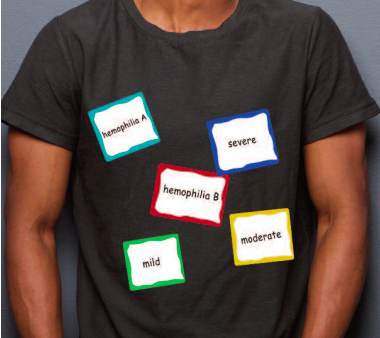
When children are diagnosed with hemophilia, they are each given an essential diagnostic label: for example, hemophilia A or hemophilia B, severe, moderate, or mild. These labels originate from a lab analysis of the child’s blood. The diagnosis determines what type of factor replacement therapy each child will get. Labels like these can help draw a picture of who your child is and what he or she needs. But when it comes to dosing and prophylaxis regimen, sport choices and bleeding patterns, and even pain management, your child with hemophilia is unique. Diagnostic labels don’t adequately explain a person’s individuality and needs.

We asked parents from Facebook about their children with hemophilia: Has anyone ever used the labels of hemophilia to categorize your child, which resulted in limiting treatment options, or limiting what people think your child can do? What is it about your child that is not “typical” for someone with hemophilia? The responses poured in. While a child’s uniqueness may be revealed in a preference for certain sports or a physiological reaction to a particular product, most of the parental responses we received were about each child’s unique half-life, and about subsequent bleeding patterns.

Half-life was barely mentioned when my son was born. In the late 1980s and early 1990s, we dosed his factor using a chart based on his weight; it was very mathematical. We took one-half of his weight in kilograms times the factor level we desired, and this equaled the number of units of factor VIII we needed to infuse. Over time, as parents, we developed intuition about how much or how little factor our son needed based on his response to factor and his bleeding patterns, and we could adjust his dosage ourselves.

Up until about the last 10 years, hemophilia treatment centers (HTCs) often prescribed factor dosages based on weight, and determined a prophylaxis regimen based on a strict protocol from clinical studies. We now know that every child needs to have a pharmacokinetic (PK) or recovery study done to determine his or her individual, unique half-life response to a specific factor VIII product. Determining the unique half-life can help hone the amount of factor a child should receive, or indicate the best prophy regimen. A short half-life may mean more frequent infusions, higher doses, or the use of extended half-life products.

If anyone knows about the uniqueness of factor half-lives in children with hemophilia, it’s June Reese, who has four sons with hemophilia. She says, “One son has always had a short half-life and has really struggled with bleeds. His teachers often compare him to his brothers, one of whom never bleeds.” And this was a problem for the Reese family: in categorizing two brothers with textbook half-lives as “normal” for hemophilia, teachers dismissed the third brother’s frequent bleeds—they thought he was being careless, or worse, that he was imagining the bleeds.

Crystal Eskine has two sons with severe hemophilia A, ages 9 and 10. “I expected two similar stories,” she laughs. Despite having the same diagnosis as his brother, Crystal’s 10-year-old bleeds spontaneously, “if you look at him too hard.” Her younger son “never needs factor,” and “he isn’t even on prophy he bleeds so little!” When Crystal’s doctor wanted her to adhere to a traditional dosage and infusion schedule with her older son, her gut instinct told her it wasn’t good enough. She knew her children’s unique responses to factor. “I started giving my older son double doses. I took notes, showed our doctor, but he still he thinks I’m worrying too much, while I still don’t think the dosing regimen is good enough.” Crystal continues, “I’ve asked for a PK test, with blood samples taken over a much longer time period, but he has said no.”

And then there is Jen Miller’s five-year-old with severe hemophilia A. Jen calls him a “typical boy” who enjoys video games, swimming, T-ball, and playing with his friends. His

factor half-life is very short, which is not typical, but this doesn’t seem to impact his bleeding patterns.

When a shorter half-life does impact bleeding patterns, and parents instinctively know something isn’t right, they need to alert their HTC staff, sometimes to prove that their child does not fit a category or label. In these cases, parents should request a PK study. Crystal laments, “My boys’ hematologist makes me feel like I’m doing something wrong, but refuses to do a PK study.” June adds, “For years, our medical staff acted as though we were to blame when he’d have bleeds—even though he was infusing regularly.”

Kate Stotz, who has a 22-month-old with severe hemophilia A, felt she had to fight against the standard prophy infusion schedule of three times a week. “This was not working for our son,” she explains. “He was having frequent bleeds on Sunday, the day he was unprotected. Trough levels indicated that in order to maintain a minimal 1% trough, we could not exceed 48 hours between infusions.” Though Kate wanted to infuse every other day to keep him protected, her son’s hematologist didn’t want to break from the traditional schedule the HTC normally prescribed. “It took a lot of advocating on our part and ultimately finding a new doctor at a different HTC.”

Sarah Hueston successfully advocated for a new prophy regimen for her 16-year-old son with severe hemophilia A, who plays two varsity sports. When they determined he had a short half-life, the HTC team, Sarah, and her son developed his treatment plan together. He now infuses standard factor daily. “It’s what works for us,” says Sarah, “and his doctors are so proud of him, as are we, his family! Never did we think he’d be doing the things he’s doing even 10 years ago!”

By logging her son’s bleeds, Stacey Mollinet was able to convince her HTC team to change the treatment schedule. When her son with severe hemophilia A was a young teenager, he didn’t bleed like a typical severe and was not very active by nature. “I had to push the HTC,” she recalls, “so he could treat only twice a week, instead of a standard prophy schedule.” Around age 14, he started to bleed more like a typical severe. So Stacey worked with the HTC to adjust her son’s dosing schedule, and ended up dosing every other day until he switched to extended half-life factor two years ago.

“There’s not a one-size solution for everyone,” Stacey has learned. “Keeping good infusion and bleed logs so you know what schedule works best to prevent bleeding is important.”

Crystal laughs, “I could probably write a book about all the ways my boys ‘differ’ from the typical definition of hemophilia.”

And in a community where boys “typically” have hemophilia while women are carriers, women are now advocating to redefine what it means to have hemophilia. Labels have their place, but when we define hemophilia and determine treatment plans, we sometimes need to look outside the box at hemophilia—and trust the parents and patients when they describe their own uniqueness and needs.

Did you miss our May issue of PEN? Download it on our website today!

HemaBlog Archives
Categories